In the age of AI, you either stay {above the algorithm}, or you work for it.
Most people in the AI conversation are selling fear or selling hype. I've been in the rooms where it gets built and deployed. Both are true. It is the most incredible tool we have ever built, and it will leave people behind unless we use it responsibly. The change is also moving faster than anything I have seen.
I view my mission simply: make sure that as the world races ahead, no one gets left behind.
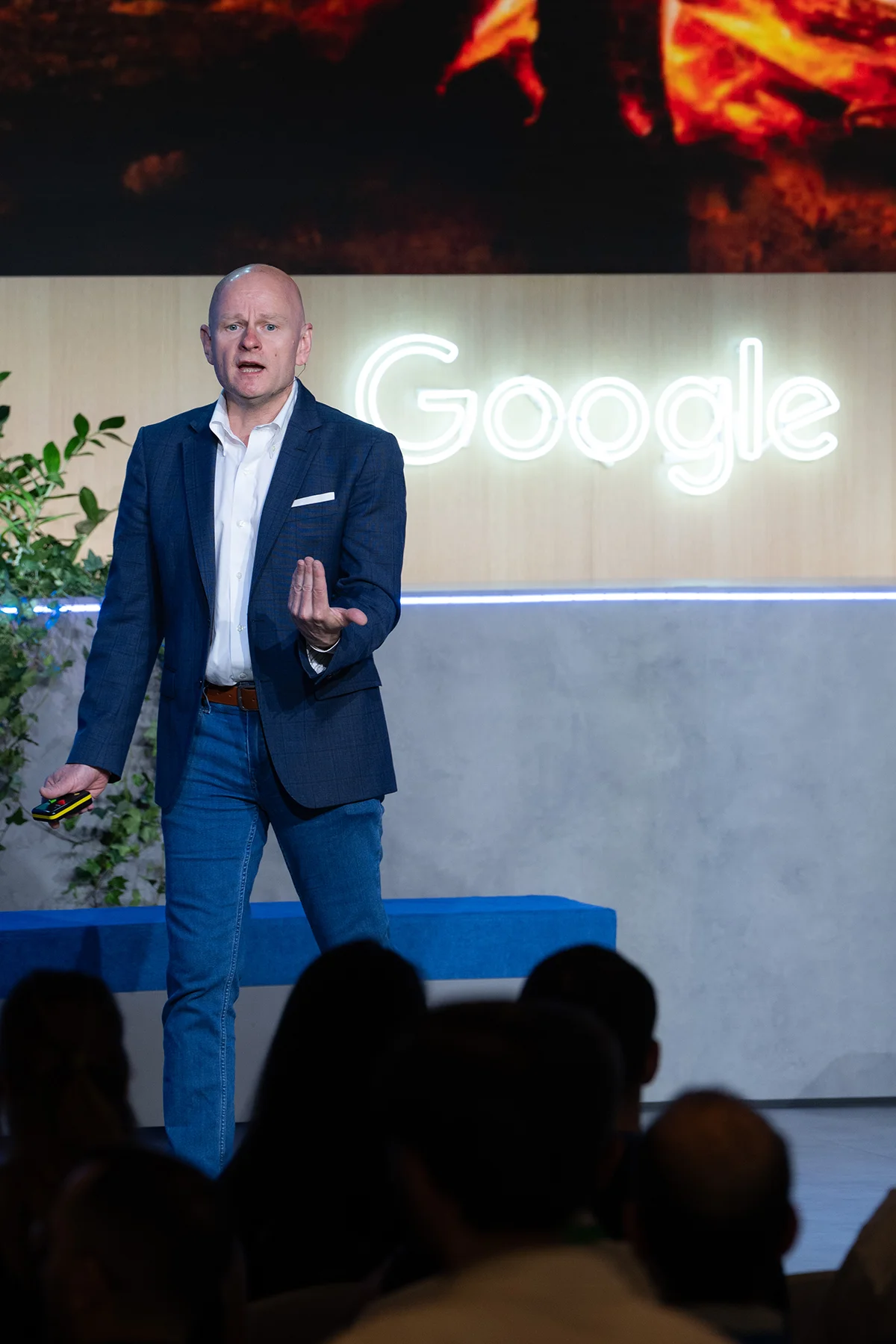
FREQUENTLY FEATURED IN:





About {Alex Goryachev}
Every organization that fails at transformation fails the same way: they invest in the tools, and {forget to invest} in the people who have to use them.
One belief, tested across every wave of disruption
My starting point
Let me be clear about where I stand on AI. It is the most incredible tool we have ever built, and it is also the one most capable of leaving people behind. Both are true at once. I have spent my career watching technology threaten people and free them in the same breath, and I will hold both truths honestly. The fear is real. So is the hope. The entire job is making sure hope wins, and that only happens when we use these tools responsibly, deliberately, and in service of the humans who have to live with them. The hard part is the speed: this is moving faster than any shift I have lived through.
The early internet years
I was an early pioneer of the commercial internet, back when digital music and entertainment were the first industries the web rewrote. I was part of Napster, the peer-to-peer platform that upended the entire music business and showed the world how fast a digital shift can dismantle an established industry. Before that, at Liquid Audio, algorithmic distribution and behavioral data at scale were the product itself, not a pitch deck. My path also ran through IBM and Pfizer, delivering enterprise technology at global scale. Across all of it, one lesson held: disruption rewards the people who stay close to the humans, not just the technology.
Scaling innovation at Cisco
At Cisco, I built a global innovation function from the ground up: a $1.1B portfolio of work spanning 14 countries (I have personally traveled to more than 66), a 72,000-person workforce, co-innovation centers on five continents, and innovation programs for three Olympic Games. We earned the awards and the case studies. The lesson that stuck was simpler: the programs that worked were the ones that made ordinary employees feel their ideas mattered. The reskilling work I am proud, because of how it treated them.
The work that matters most now
Today the work that matters most to me is education and reskilling, which I believe is the single most important job of this century. As AI rewrites what work is, lifting every worker and learner with it is both a moral and an economic imperative. It is one of the honors of my life to work with the California State University system, the largest public university system in the United States, on its AI Insights strategy: understanding the impact AI has on learning and the workforce of the future.
That commitment to education runs through my work across academia, as Innovator in Residence at Tulane University and as a Fellow of the Royal Society of Arts. It is the same thinking I have carried into rooms for Google, AWS, Bosch, Coca-Cola, and Rotary International, and into advisory work, having advised both Dell, where I helped build a world-class AI consultancy, and Amgen, where I worked on early AI pilots. The tools keep changing. The conviction never does: innovation is never about the technology, it is always about the people.
Three moves to stay {above the algorithm}.
A model I bring to every organization I work with, from Fortune 50 boards to the largest public university system in the country. As AI gets better at the work and the pace keeps accelerating, one position stays durable: keeping people above the algorithm, not beneath it. Three moves get you there.
Adapt or vanish
The tech cycle now moves faster than the org chart. Build the muscle to change continuously, with measured experiments, fast learning, and real outcomes, so you lead the pace instead of chasing it.
Invest in what only people have
Judgment, trust, creativity, and taste are the durable advantage. Develop the human capabilities AI amplifies rather than replaces, and point your people squarely at them.
Democratize the tools
Value compounds when the whole workforce can build with AI. Hand everyone a maker space, spread the skills wide, and let the best ideas come from anywhere in the organization.
Things I believe about AI and innovation
"Adapt or vanish" is a literal description of the timeline.
Most organizations are pricing in a slower AI timeline than the one actually arriving. The gap between the fast adapters and everyone else widens by the month, and it closes for no one.
Innovation is rarely born in corner offices.
The best ideas usually come from the people closest to the problem, not the people highest on the org chart. The organizations that win know how to pull them up from every level.
Education and reskilling are the defining work of our era.
As AI changes what work is, the highest-leverage investment any leader or country can make is in the skills of their people. Get that right and almost everything else follows.
It is not the future that kills great companies. It is loyalty to the past.
The most dangerous phrase in any boardroom is "this is how we have always done it." Incumbents rarely fall because the technology beat them; they fall because they defended yesterday's success long after the world moved on.
Automation is wonderful, right up until you automate the one person who actually understood how anything worked.
The org chart never shows where the real knowledge lives. Automate without understanding it first, and you scale the gaps right alongside the gains.
Get above the algorithm, or get automated.
Plenty of people will let the algorithm set the agenda and grade the work. The real advantage belongs to those who keep direction, judgment, and the final call human, and treat AI as leverage instead of a leash.
Hiring a Chief AI Officer to "handle the AI" is like hiring a Chief Electricity Officer in 1920.
AI is not a department you can delegate to. It is the new wiring in the whole building, and everyone has to learn where the switches are.
Your employees are already using AI. The only question is whether they will tell you.
Shadow AI use is already the default. Employees reach for personal accounts and unapproved tools because the policy took longer to write than the problem took to appear, and the work still has to ship today. A ban just costs visibility. A sanctioned path that ships faster than the workaround gets both control and real adoption.
Half of what gets sold as an "AI strategy" is a slide deck with a robot on it.
Real strategy survives contact with a P&L. If your plan changes nothing about how work actually gets done on Monday, it is decoration, not direction.
A PERSONAL NOTE
Here is what keeps me in this work. In every organization there is someone in the back of the room who is afraid that AI is going to leave them behind. I think about that person constantly. The reason I write, and teach, advise and step on stages at all is to make sure they walk out believing they still have a place in what comes next. The speed of change is real, and for a lot of people it is frightening. But I have seen what happens when leaders choose to bring everyone with them, and it is the most hopeful thing I know.
Let's build that for your people.
This page is the {why}.
The proof lives next door.
The 30-year track record
Dell, Amgen, CSU, Cisco, Napster, IBM: the full career arc, the portfolio, the awards, the numbers.
What changed afterward
The outcomes organizations walked away with, from agentic-AI adoption to workforce reskilling at scale.
ALEX, BY THE NUMBERS

Why Audiences Love {Alex}
Eye-opening, refreshingly human, and capable of building a shared vision around agentic AI — that's how leaders at Coca-Cola, AWS, and Disney describe Alex Goryachev's AI keynotes and employee innovation workshops.
Innovation for everyone
Alex turns AI into practical concepts — not techspeak — that land with executives, HR, sales, engineering, and faculty alike. It's the same approach he honed building university-anchored innovation centers across 14 countries, bridging cultures and generations.
Built around your audience
Across 310+ keynotes, workshops, and advisory engagements on 6 continents, no two have ever been the same. Alex builds every program around your audience's challenges, industry, and goals — from agentic AI strategy and the future of work to innovation culture.
Value that lasts
Most programs end at applause. Alex's end with deployment — the same frameworks proven inside Cisco, Dell, Pfizer, and IBM and documented in his WSJ bestseller Fearless Innovation. Workshops and advisory install them in your team, so they're still running long after the event.
Proven where it counts
Two decades leading AI and innovation where the stakes are real — a $1.1B portfolio at Cisco, three Olympic Games, 300,000+ employees, and AI transformation for Fortune 100s, governments, and America's largest public university system. Every engagement is measured, so you see the ROI.
Your team will thank you
A 60-minute keynote, a hands-on workshop, a virtual session, or multi-month advisory — for enterprises, universities, and associations alike. Whatever the format, 98% of audiences say they would recommend him.
Request Alex's availability for your engagement. From Silicon Valley to Singapore, and everywhere in between.
310+ Keynotes, Workshops & Advisory Engagements



















.svg.webp)





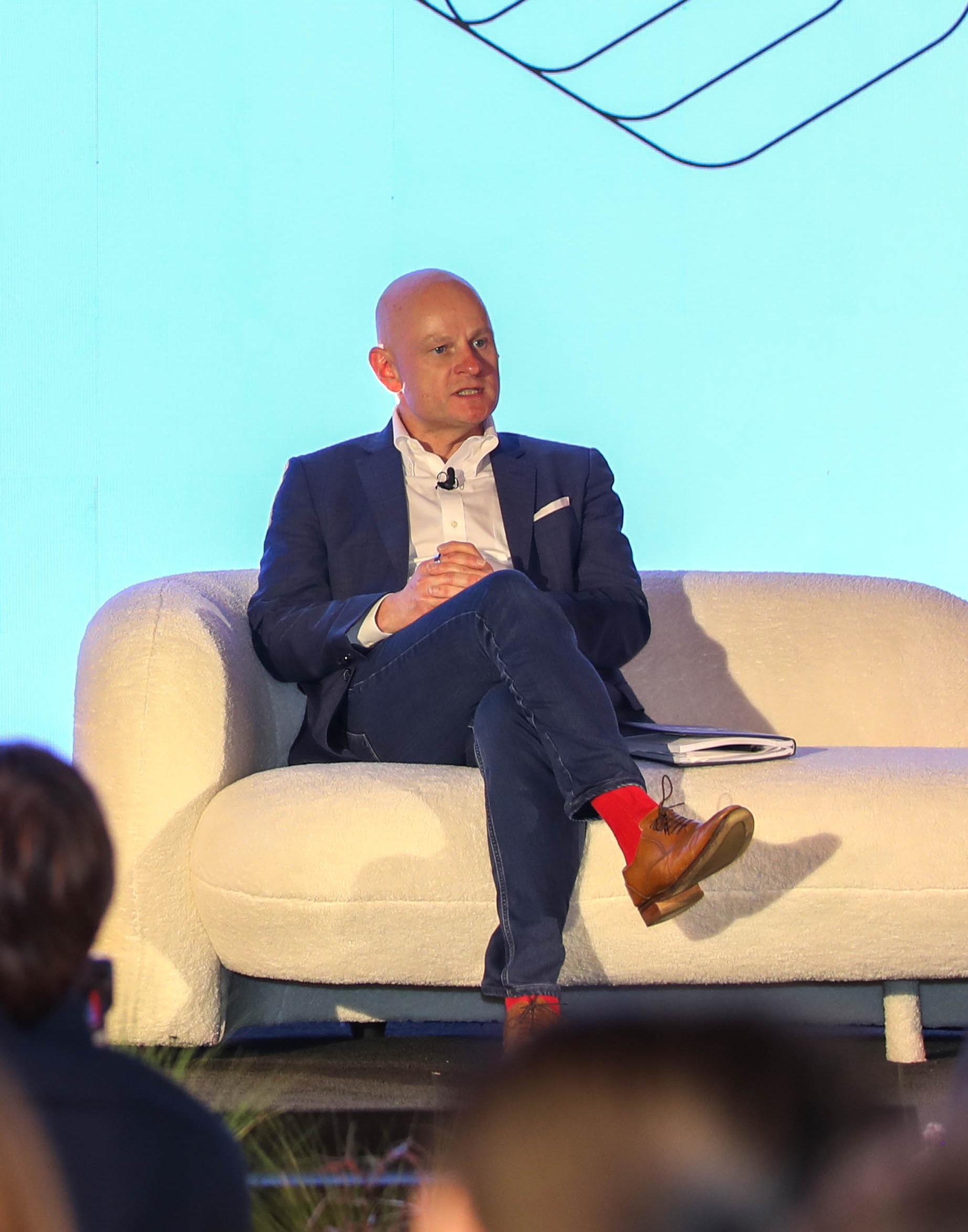
Book an AI keynote speaker for your event.
Looking to book an AI keynote speaker for your next conference, leadership retreat, or all-hands? Tell us about your audience and we'll match the right keynote to your moment.
Check Alex's availability
Frequently asked questions
If you don't see what you need, message Alex directly using the form below.
Is Alex Goryachev a good AI keynote speaker?
Alex Goryachev holds a 98% would-recommend rating from audiences, measured by Talkadot across 582+ verified responses, with 91% calling the content actionable. Organizations that have booked him include Google, SHRM, and IEEE, alongside universities and associations. The material comes from nearly two decades running innovation inside Cisco, so leaders leave with steps they can run inside their own teams. Every session is customized to the audience's industry and AI maturity.
Who is Alex Goryachev?
Alex Goryachev spent nearly two decades at Cisco before becoming an AI keynote speaker and advisor. As Managing Director of Innovation Strategy and Head of Global Innovation Centers, he built innovation centers in 14 countries on 5 continents and ran the Innovate Everywhere Challenge, which engaged about half of a 72,000-person workforce. He wrote Fearless Innovation (Wiley), a Wall Street Journal bestseller, contributes to Forbes, and has 212 publications to his name. He now advises the California State University system, 22 campuses and 460,000 students, on AI.
Is Alex Goryachev a practitioner or a futurist?
Alex Goryachev is a practitioner. For nearly two decades he built AI and innovation programs inside Cisco, a Fortune 100 company, before taking the stage full time. He created university-anchored innovation centers in 14 countries on 5 continents and ran innovation tracks for 3 Olympic Games. That record is why his sessions cover sequencing, budget, and the failure modes he watched up close.
What qualifies Alex Goryachev to speak on AI?
Alex Goryachev's qualification rests on operating results, published work, and standing advisory roles. He ran a $1.1B innovation portfolio at Cisco that generated $400M+ in revenue and reached 300,000+ employees with innovation and AI programs. His book Fearless Innovation was a Wall Street Journal bestseller, and he has 212 publications and a LinkedIn Top AI Voice designation. Universities keep him close: he is Innovator-in-Residence at Tulane and advises the California State University system on AI governance.
What does Alex Goryachev speak about?
Alex Goryachev speaks about agentic AI strategy, AI governance, innovation culture, and the future of work and learning. The material comes from his Wall Street Journal bestseller Fearless Innovation (Wiley), his Forbes columns, and from his work advising the California State University system on AI and governance across 22 campuses. His book in progress, The Great Relearning, covers the shrinking half-life of skills and treats reskilling as a survival question.
Where is Alex Goryachev based?
Alex Goryachev lives and works on the West Coast of the United States, and he has personally traveled to 66+ countries. His speaking has taken him to 6 continents across 310+ keynotes, and the innovation centers he built at Cisco spanned 14 countries on 5 continents. Solutions from that work were deployed in 40 countries. Time zones rarely limit a booking, since he delivers virtually as well as in person.

.svg)

