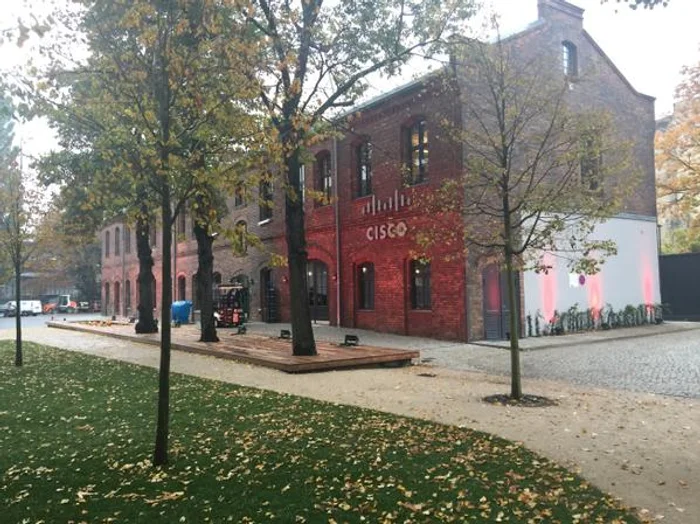
New Berlin Innovation Center Accelerates ‘Network

At yesterday’s inauguration of Cisco’s ninth Innovation Center in the world, Berlin’s smartest new facility was abuzz with startup-like excitement for the possibilities of what the new digital world can deliver. I mingled with Cisco colleagues, customers, partners, app developers, entrepreneurs, thought leaders, and the media in our latest showcase working lab, embedded with more than 10,000 sensors and all the networking hardware and software needed to co-innovate industrial solutions around the Internet of Things (IoT).
Indeed, the world is increasingly more connected. Some 13 billion devices are now connected through the Internet. And now, openBerlin, a Cisco® Innovation Center will link with an inter-connected network of eight other Innovation Centers in major cities around the world, sharing local expertise to support the development of the latest outcome-based solutions that can be scaled and replicated globally.
Our Commitment to Startups
We’re so bullish about the potential of this super hub, and the entrepreneurial talent of the region, that Cisco is investing US$30 million in the center over the coming years. In addition, we are making a significant equity investment in StartUpbootcamp Berlin, an internationally known startup accelerator focused on IoT innovations. This is part of a broader commitment to its portfolio of startups.
In the world of networks, we talk about the “multiplier effect,” which increases the value of the network the more it grows with users and participants. openBerlin, a Cisco® Innovation Center will accelerate exponential value not only for Cisco’s Innovation Centers collectively but also for our customers and partners who want to capture their share of the $19 trillion opportunity from the Internet of Everything (IoE), the connection not only of things but also of people, processes and data.
Berlin is the ideal location for the latest extension to the Cisco Innovation Center program. Berlin is the capital of Germany, the world’s fourth-largest economy, and is a global hub for high-tech and services firms tapping into its talent reservoir of engineers and innovators. Further, Germany already has embraced the digitization of society and industry through its own Industrie 4.0 initiative, which complements IoT and IoE.

Each Cisco Innovation Center, which brings together an ecosystem of customers, partners, and developers, focuses on technology and business solutions that capitalize on the region’s particular technology and industry strengths. For example, the Berlin center will focus on digital innovation in manufacturing, logistics, transportation, and utilities, offering co-innovators an open digital platform to build their solutions and also serves as a portal to enter global markets. The 10,000 sensors I mentioned earlier can collect and analyze data for room temperature, lighting, and power consumption turning disruptive ideas into new business solutions.
Berlin now joins our innovation super hubs in Tokyo, Japan; London, England; Paris, France; Sydney and Perth, Australia; Barcelona, Spain; Rio de Janeiro, Brazil; Songdo, South Korea; and, Toronto, Canada.
Collectively and individually, I am excited, optimistic, and confident about the world of possibilities that we and our partners are bringing to life at the Cisco Innovation Centers.
This article originally appeared on Cisco Blogs on October 16, 2015
Ready to bring these AI insights to your organization? Alex Goryachev delivers AI innovation keynotes and strategic AI advisory to help business leaders navigate the AI landscape with confidence.

.svg)

