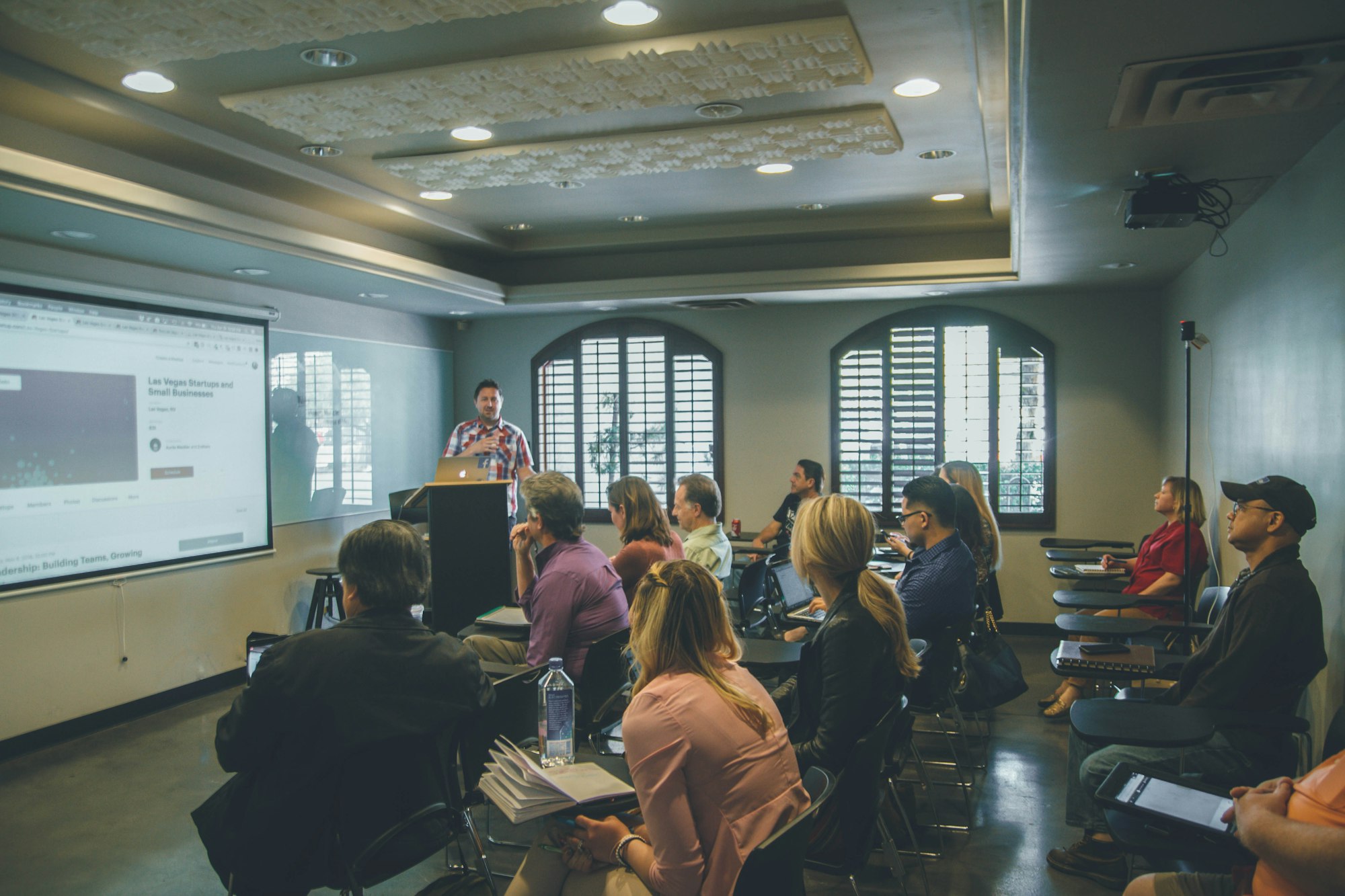
AI Innovation Workshops for Faculty and Professional Associations

A 90-minute structure sends each participant home with a finished artifact and a named owner, whether the audience is a faculty department or an association annual meeting.
Key Takeways
- An AI innovation workshop earns its time when each participant leaves with one finished artifact, such as a revised assignment or a working prompt library.
- Faculty workshops cover three sessions: information literacy, assessment redesign with an AI citation protocol, and participatory design of a learning operation.
- Association workshops run 90 minutes inside the convention schedule, with each table testing AI on one recurring member task.
- Every workshop should end with a named owner, a task, and a date, because that turns the session into a pilot.
Bring Alex to your organization: keynotes, workshops and advisory, in person or virtual. Check Alex's availability
Faculty at a university and members at an association annual meeting arrive at an AI workshop with the same question: what do I do on Monday? I have delivered 310+ keynotes on 6 continents, and the workshops that last are built around a task each participant already owns. After nearly two decades at Cisco, where I helped shape a $1.1B innovation portfolio and established innovation centers in 14 countries on 5 continents, I use one design for both audiences. This article lays out how I structure AI innovation workshops for university faculty and staff and for professional associations.
What an AI innovation workshop produces
A workshop earns its time when every participant leaves with a finished artifact. For a faculty member that is a revised assignment or a course policy on AI use. For an association member it is a working prompt library for one recurring task, such as drafting member communications or summarizing regulatory updates. A keynote gives an audience a shared picture of where AI is going. A workshop turns that picture into work product.
A workshop earns its time when every participant leaves with a finished artifact.
AI innovation workshops for university faculty and staff
Faculty arrive with different levels of experience and different disciplines, so I open with one shared problem and let each person solve it in their own course. I advise on AI at the California State University, a system of 22 universities and 470,000+ students. A CSU survey of 94,000+ respondents found that 95% have used generative AI, which means most faculty teach students who already use it. A faculty workshop starts from that fact.
Three working sessions carry the day. The first covers information literacy: faculty test an AI tool against sources they know well and record where it is accurate and where it invents. The second covers assessment: each instructor rewrites one assignment so that the learning goal holds when a student uses AI, and writes a one-paragraph citation protocol for AI-generated work. The third is a participatory design session where staff map one learning operation, such as advising or course support, and mark which steps a person should keep. Staff and faculty work in the same session because the handoffs between them are where most of the friction sits.
AI training at association annual meetings
An association workshop runs inside a convention schedule, so it competes with sessions, exhibits, and networking. Members give it 90 minutes only if it returns something they can use at the office the next week. I build these sessions around the member's own work. Each table takes one recurring task from their own work, tests an AI approach on it, and reports back what saved time, what needed a human check, and what the team should leave alone.
The networking benefit is part of the design. Members at the same table share a profession and share a regulator, a customer, and a staffing problem, so the comparison between tables becomes a peer benchmark they could not get from a vendor demo. The association gains a record of the tasks its members chose, which tells staff where to build programming next year.
A 90-minute structure that works in both settings
I use the same four blocks for faculty and associations, and I adjust the examples. The first 10 minutes name one task each participant owns. The next 30 minutes are hands-on, with participants running an AI tool against that task. The following 30 minutes are a review in pairs, where each person marks the steps that need human judgment. The final 20 minutes produce the artifact and one named owner for the next step.
The named owner matters most. A workshop with no owner afterward becomes a pleasant memory, while a workshop that ends with a person, a task, and a date becomes a pilot.
What to ask a facilitator before booking
Ask which artifact each participant will leave with, because a facilitator who cannot name it is selling a presentation. Ask how the session adapts to a mixed audience of beginners and heavy users. Ask what the facilitator has run for your type of audience, whether faculty, staff, or association members. Ask what follow-up exists at day 30, since adoption shows up in the weeks after the session.
To discuss a workshop for your faculty or your annual meeting, the booking page for AI innovation workshops is the place to start.
What should participants prepare before an AI innovation workshop?
Ask each participant to bring one recurring task they own, along with a sample that contains no confidential material. Faculty can bring a current assignment and association members can bring a standard member communication. A prepared task lets the session start at hands-on work in the first 10 minutes.
How does a workshop handle student or member data?
The session uses public or invented examples only, so no student records or member files enter an AI tool. Participants decide afterward which approved tools their institution or association permits for real data, and that decision goes to the named owner.
Alex Goryachev is a WSJ-bestselling author and AI keynote speaker who designs AI innovation workshops for university faculty and professional associations.
To plan a workshop for your campus or annual meeting, book a conversation →


