AI Keynote Speaker FAQs — Booking, Fees, Topics & What to Expect
If you don't see what you need, message Alex directly via the form below — answers usually within one business day.
FREQUENTLY FEATURED IN:





Who is Alex Goryachev?
Alex Goryachev is an AI keynote speaker and strategic advisor who has delivered 310+ keynotes on six continents. As Managing Director of Innovation Strategy and Head of Global Innovation Centers at Cisco, he shaped a $1.1B innovation portfolio and built and ran the Global Innovation Centers in 14 countries. Last quarter, 99% of 676 verified attendees found his talks valuable, measured by Talkadot. He is the author of Fearless Innovation (Wiley), a Wall Street Journal bestseller.
What makes Alex Goryachev different from other AI keynote speakers?
Alex Goryachev built the AI and innovation programs he now teaches. At Cisco he shaped the $1.1B innovation portfolio, built and ran the Global Innovation Centers in 14 countries and created the Innovate Everywhere Challenge. He has since advised Dell's GenAI practice and Amgen, and Google and AWS bring him in to brief their customers. Last quarter, 91% of 676 verified attendees rated his content actionable.
Who does Alex Goryachev work with?
Alex Goryachev works with global enterprises, universities and education systems, governments and associations. Enterprise audiences have included teams at Google, IBM, Disney, Pfizer and Visa, and Google and AWS bring him in to brief their customers. In higher education he has advised the California State University system on AI strategy and governance, and he is Innovator-in-Residence at Tulane University. He has delivered 310+ keynotes on six continents.
What topics does Alex Goryachev cover on stage?
Alex Goryachev's keynotes cover agentic AI strategy, AI governance, the future of work and innovation culture. Each session is built around the audience's industry and AI maturity. The examples come from his Cisco years, including shaping the $1.1B innovation portfolio and creating the Innovate Everywhere Challenge, which produced 1,100+ internal startups from 2,000+ teams. Every talk closes with actions leaders can take the following week.
How are Alex Goryachev's audience ratings measured?
Talkadot, a third-party feedback platform, measures Alex Goryachev's audience ratings from verified attendee responses. Attendees rate the session as it ends, and organizers see the raw results. Last quarter, 676 verified attendees across 13 engagements responded: 99% found the talk valuable, 97% would see him again and 91% rated it actionable. Alex does not collect, edit or filter the feedback, and the full report is available from Talkadot.
How much does it cost to book an AI keynote speaker?
The cost to book an AI keynote speaker depends on format, travel and session design, along with how much of the talk is built new for your audience. Many organizations book the virtual format or pair a keynote and a workshop on the same trip to make the budget go further. For Alex Goryachev, every engagement is scoped to your format, audience and travel. You get availability and a fee range within one business day.
Who is the best AI keynote speaker for 2026?
The best AI keynote speaker for 2026 has deployed AI at your scale and can prove audience impact with third-party data. Alex Goryachev meets both tests: he shaped Cisco's $1.1B innovation portfolio and built and ran its Global Innovation Centers in 14 countries. Last quarter, 99% of 676 verified attendees found his talks valuable, measured by Talkadot. Shortlist two or three speakers on those tests and ask each one for their numbers.
What session formats and lengths does Alex Goryachev offer?
Alex Goryachev delivers conference keynotes, executive workshops, virtual sessions and lunch and learns for smaller teams. In-person sessions are sized to your agenda. Online, a keynote runs 45 to 75 minutes, a lunch and learn 60 minutes and a working session or sprint 90 to 120 minutes. Content is rebuilt for each audience whatever the format, so a workshop gets the same tailoring as a main-stage keynote. His in-person dates have reached audiences on six continents.
What does it cost to book Alex Goryachev?
The cost to book Alex Goryachev depends on format, audience and travel, and every engagement is scoped to all three. You get availability and a fee range within one business day. A booking covers more than stage time: a briefing with the organizer, audience research, a customized talk and audience feedback collected afterward through Talkadot. Travel and workshop days are scoped separately. Send your date, audience and format through the contact page.
Where is Alex based, and does he travel?
Home base for Alex Goryachev is the West Coast of the United States, and he travels for events worldwide. West Coast and Southern California dates are simple to schedule, and he has delivered 310+ keynotes on 6 continents. International travel is quoted with the event, following the organizer's travel policy. Virtual delivery covers audiences in other time zones. Send a city and date through the contact page to check availability.
Does Alex Goryachev do advisory work beyond keynotes?
Alex Goryachev takes on advisory work alongside keynotes, including multi-month engagements, AI leadership programs and executive workshops on putting AI into production. He has advised Dell's GenAI practice, Amgen and the California State University system on AI strategy and governance. Google and AWS bring him in to brief their customers. Most engagements open with a short conversation to map the organization's AI maturity, then get scoped from there.
How do I book Alex Goryachev as an AI keynote speaker?
To book Alex Goryachev, send the date, audience and goals through the contact page. You get availability and a fee range within one business day. A booked engagement includes a planning call where he maps the audience's AI maturity and picks examples to match. Dates are held once the contract is signed. Delivery is available in person worldwide or virtually.
Will AI take my job?
AI will take some jobs, and entry-level hiring is where the effect shows up first. The more useful question is whether your organization plans to relearn you or replace you. Alex Goryachev, who measures how fast people and organizations relearn, treats relearning speed as the decisive skill of the agentic AI era. Employees who can rebuild their own work around new tools are the hardest to replace, and employers that train for it keep the experience they already paid for.
Is it too late to start with AI?
No, it is not too late to start with AI, because most of your peers are further behind than their press releases suggest. Public announcements tend to describe pilots, and far fewer organizations have changed how work actually gets done. Alex Goryachev, who tracks how fast organizations relearn, points out that a later start lets leaders skip the failed experiments others already ran. The organizations that pull ahead from here will be the ones that relearn fastest, starting with one team and one real process.
Who is a top advisor for enterprise AI adoption?
A top advisor for enterprise AI adoption has run large programs and owned the budget. Alex Goryachev meets that test. As Managing Director of Innovation Strategy and Head of Global Innovation Centers at Cisco, he shaped a $1.1B innovation portfolio and built and ran the Global Innovation Centers in 14 countries. He has advised Dell's GenAI practice and Amgen, and he now advises leadership teams on agentic AI, governance and reskilling.
What does a Fortune 500 company get from an AI keynote?
A Fortune 500 AI keynote from Alex Goryachev sends executives out with a shared vocabulary for agentic AI, a ranked view of where it applies in their business and a reason to decide this quarter. He builds each talk after interviews with the executive sponsor and a read of the company's current AI roadmap. He has done this for audiences at Disney, AWS, Dell and Amgen. Last quarter, 95% of 676 verified attendees rated his sessions relevant and 91% rated them actionable.
What is the ROI of an AI keynote for an enterprise?
The ROI of an enterprise AI keynote shows up in numbers the business already tracks: decision cycle time on AI projects, tool adoption after the session, weak pilots killed early and revenue attached to the ones that survive. Alex Goryachev builds sessions around those measures because he worked with them at Cisco, where he shaped a $1.1B innovation portfolio. Agree on the two metrics you will track before the date is booked.
Which workflows should enterprises give to AI agents first?
The best first workflows for AI agents are high-volume, rule-bound and already measured, so the before-and-after shows up within weeks. Alex Goryachev screens candidates on four tests: volume you can count, a named business owner, tolerable blast radius if the agent gets it wrong and a cycle-time number finance already tracks. Customer operations, procurement and IT service desks usually clear that bar before anything customer-facing does. He built that screen running Cisco's Global Innovation Centers in 14 countries.
How does Alex Goryachev address AI governance and risk?
Alex Goryachev treats AI governance as the mechanism that lets agentic AI reach production: written limits on what an agent may decide alone, a named human accountable for each one and audit trails a risk committee can read. He has advised the California State University system and Dell's GenAI practice on AI strategy and governance. Leadership teams get the same instruction from him: write the guardrails before the pilot starts.
What is an agentic enterprise?
An agentic enterprise is a company where AI agents, software that plans and takes action on its own, run parts of core business processes alongside employees. Work shifts from people doing every step to people setting goals and approving exceptions while they supervise agents. Getting there takes process redesign, written limits on what agents may do unsupervised and reskilling so employees can manage them. Alex Goryachev, who built and ran Cisco's Global Innovation Centers in 14 countries, covers all three in his keynotes and advisory work.
How do enterprises adopt agentic AI successfully?
Successful agentic AI adoption starts small and stays measured. Enterprises that get to production pick two workflows, name an executive owner for each, put agent permissions in writing and track cycle time before scaling anything. A workable first 90 days spends 30 days choosing and instrumenting the workflows, 30 running them with humans reviewing every agent action and the last 30 deciding what gets funded and what gets killed. Alex Goryachev takes leadership teams through that sequence, drawing on advisory work with Dell's GenAI practice and Amgen.
Why do most agentic AI projects fail?
Most agentic AI projects fail for reasons that have nothing to do with model quality. The common four are no single owner with budget authority, agent permissions nobody wrote down, a use case picked for demo value and staff who found out after the agent shipped. Gartner expects more than 40% of agentic AI projects to be cancelled by 2027. Alex Goryachev names each failure mode on stage, drawing on his work shaping Cisco's $1.1B innovation portfolio and advising Dell's GenAI practice.
Why do enterprises hire a practitioner over a consulting firm?
Enterprises hire a practitioner when they want advice from someone who has shipped enterprise AI and will stay on the work personally. Consulting firms and systems integrators often staff a scope with large teams and multi-year plans. Alex Goryachev works with one scope of work, delivered by him. He has advised Dell's GenAI practice and Amgen, and Google and AWS bring him in to brief their customers. His past work includes IBM and Pfizer.
Does Alex work with mid-market companies, or only Fortune 500s?
Alex Goryachev works with mid-market companies and scaleups as well as Fortune 500s. Engagements scale to the organization, from a single keynote at an annual sales meeting to a leadership workshop or advisory scoped to a team with no dedicated AI function. Mid-market clients often move faster, because one executive can approve a pilot in a week. You get availability and a fee range within one business day.
Why isn't our AI investment paying off?
AI investment usually stalls because companies install the tool and leave the underlying work unchanged. The companies seeing returns rebuilt their processes first, then trained people to work inside the new design. Alex Goryachev, who shaped Cisco's $1.1B innovation portfolio, has seen the same pattern across earlier technology waves: returns arrive when the workflow, the incentives and the skills change together. Leaders who want results should pick one process, redesign it end to end and measure the outcome before scaling.
How do I get employees to actually use AI?
Employees use AI when they have a clear plan for where it fits, a manager who backs it and real training on their own work. Those factors matter more than the choice of tool. Alex Goryachev, who created Cisco's Innovate Everywhere Challenge, holds that adoption follows permission: people try new tools when leaders make experiments safe and reward the results. Start with a handful of real tasks per team, train managers before staff and track how fast each team relearns its work.
How do I explain AI to my leadership team without hype?
Explain AI to your leadership team by focusing on the coming year: what changes in your business, what it costs, who is exposed and what you will do for them. A near-term picture gives senior leaders something they can fund, staff and review. Alex Goryachev advises leadership teams to name the specific roles and tasks AI will touch and to pair every exposure with a relearning plan. Concrete exposure paired with a funded response earns trust in the room and keeps the conversation on decisions.
What qualifies someone to speak on AI in education?
Credibility on AI in education comes from operating experience with a live deployment at institutional scale. Alex Goryachev clears that bar. He has advised the California State University system on AI, and he is Innovator-in-Residence at Tulane University's A.B. Freeman School of Business. Add 310+ keynotes on six continents, with 99% of 676 verified attendees finding his talks valuable last quarter, and the subject-matter credibility comes with stage skill.
Which education institutions does Alex Goryachev work with?
Alex Goryachev's education work spans public university systems, individual campuses, business schools and national conferences. He has advised the California State University system on AI and is Innovator-in-Residence at Tulane University's A.B. Freeman School of Business. He is a lecturer at Virginia Commonwealth University and has lectured at Cornell, Wharton, the University of Delaware and UT Dallas. Engagements start through the contact page.
Does Alex Goryachev speak on the future of learning?
Keynotes on AI in education and the future of learning make up a large share of Alex Goryachev's calendar, delivered to university cabinets, faculty senates, school system leaders and national education conferences. His advisory work with the California State University system supplies much of the material, including agentic AI in campus operations. Booking runs through the contact form at alexgoryachev.com, and you get availability and a fee range within one business day.
What does agentic AI mean for universities?
Agentic AI, meaning software that takes actions on its own, will change university operations before it changes the classroom. Enrollment, advising, financial aid and research administration are the first workflows where it runs end to end. Alex Goryachev tells university leaders to pilot in operations first, where the savings are countable, and to write governance rules before the first agent goes live. He has lectured on AI at Cornell, Wharton, UT Dallas and the IEEE Future of Education conference.
What is the future of education in the age of AI?
The future of education is personalized and lifelong, with AI assisting at every stage, and human mentorship becomes the scarcest thing a campus offers. Within a decade most students will study alongside an AI tutor and most campuses will run administrative work through AI agents. Institutions that treat AI as infrastructure will pull ahead. Alex Goryachev, author of the Wall Street Journal bestseller Fearless Innovation, keynotes on that shift for universities and education conferences.
What is an AI-native university?
An AI-native university builds AI into teaching, operations and governance from the ground up. In practice that means an AI tutor available to every student, agentic AI running back-office workflows and AI oversight as a standing responsibility of institutional leadership. Few campuses are close to that today. Alex Goryachev works with presidents, provosts and cabinets to turn it into a funded roadmap with named owners and dates.
How are university systems deploying AI at scale?
University systems deploying AI at scale pair licenses with governance and faculty enablement from the start. The California State University system's ChatGPT Edu rollout across 22 campuses is one of the largest examples in public higher education. Alex Goryachev has advised the California State University system on AI and governance, and he takes the sequencing lessons from that work into keynotes and leadership sessions with other institutions.
How should universities prepare students for AI at work?
Universities should treat AI fluency as a general education requirement, taught in every major. That means AI tools inside ordinary coursework, more weight on the judgment and collaboration skills employers still pay for and industry partners involved in curriculum design. Alex Goryachev built and ran Cisco's Global Innovation Centers in 14 countries with university partners including Imperial College London, Keio University, École Polytechnique, the University of Toronto and UNSW Sydney, and he brings that model to individual campuses.
What should students be allowed to do with ChatGPT?
Students should get written rules that name the allowed uses of ChatGPT assignment by assignment, since a blanket ban collapses the moment enforcement is tested. Workable policies let students use AI for brainstorming, outlining and revision while requiring disclosure and defensible authorship of the final work. Alex Goryachev has advised the California State University system, where 460,000 students have licensed access to ChatGPT Edu, and he helps campuses write student-facing rules in language undergraduates follow.
How do faculty audiences differ from corporate audiences?
Faculty audiences test a speaker's sources in a way corporate audiences rarely do, and they push back in the room during the session. A talk that works in a sales kickoff dies in a faculty senate if the examples come from vendor decks. Alex Goryachev builds higher education programs from campus interviews and published research. Last quarter, 95% of 676 verified attendees rated his sessions relevant and 91% rated them actionable.
How should universities govern AI?
University AI governance works best as a standing cross-functional body with named decision rights and a budget. One-time task forces issue a report and disband. The body needs authority over four areas: academic integrity, data privacy, procurement and faculty and student use. Alex Goryachev has advised the California State University system on AI governance across its 22 campuses, and he helps single institutions stand up equivalent structures in about 90 days.
What is AI literacy and why does it matter?
AI literacy is the shared ability of faculty, staff and students to use AI tools well and to know when to hold back. It matters because adoption without literacy produces uneven outcomes and privacy mistakes, along with integrity cases that hearing panels cannot resolve. Alex Goryachev runs AI-literacy sessions from cabinet level to classroom level, tied to the same governance work he has done advising the California State University system. Literacy and policy land together or neither one sticks.
Will AI replace teachers and professors?
AI will not replace teachers and professors, though it will take over a meaningful share of what they do now, and some teaching jobs will go with it. Grading, content delivery and first-line student questions are already moving to machines. Institutions under enrollment pressure will use those savings to run larger sections with fewer instructors. Alex Goryachev, Innovator-in-Residence at Tulane University's A.B. Freeman School of Business, tells faculty the defensible work is mentorship, judgment and motivation, and that retraining for it starts now.
Is a college degree still worth it in the age of AI?
A college degree still pays, and the premium is narrowing for programs built on routine knowledge work that AI now does cheaply. Degrees that train judgment, collaboration, communication and AI fluency hold their value, while a degree that mostly certifies recall of transferable facts is losing value. Alex Goryachev, author of the Wall Street Journal bestseller Fearless Innovation, works with provosts and cabinets on which programs to redesign, which to merge and how to say so honestly to prospective students.
What does AI mean for reskilling the workforce?
Reskilling becomes a permanent function under AI, because AI keeps shortening the shelf life of the skills people were hired for. Expect credentials to move toward stackable, verifiable units and toward standing partnerships between universities and employers. Alex Goryachev built and ran Cisco's Global Innovation Centers in 14 countries, many anchored at universities, and has a book in progress, The Great Relearning, on the shrinking half-life of skills.
What should education leaders do about AI right now?
Education leaders should do three things this term: publish a usable AI policy, train faculty and staff hands-on and put one visible pilot into production within 90 days. Waiting for regulatory clarity carries more risk than acting, because students and staff are already using these tools without rules. Alex Goryachev, who has advised the California State University system on AI, runs leadership sessions that end with a dated 90-day plan and named owners for each item.
How do you introduce AI to faculty without losing them?
Faculty adoption starts with workload: grading, course prep, letters of recommendation and committee paperwork, where AI returns hours in the first week. Mandates and hype produce the opposite result. Alex Goryachev runs hands-on faculty workshops built around the tasks instructors already resent, with department-level examples. Last quarter, 91% of 676 verified attendees rated his sessions actionable, which matters with a room that came in skeptical.
How does Alex Goryachev work with speaker bureaus?
Alex Goryachev works with speaker bureaus on a non-exclusive basis and is not signed to any single agency. Bureau-sourced engagements run on the agency's standard terms, agreed at the time of booking, and repeat business from that client stays with the bureau that introduced it. Bureaus get availability and a fee range within one business day, along with bios, headshots and program descriptions ready to submit. Every keynote is built around the client's audience.
What does a bureau need to submit Alex Goryachev?
A bureau submission for Alex Goryachev needs six things: date and hold window, city or platform, audience size and seniority, format, the client's theme and the client's budget. His team returns availability and a fee range within one business day, with a courtesy hold. Bureau-ready assets already exist: long and short bios, high-resolution headshots, program descriptions, a speaking reel and Talkadot data from 676 verified attendees last quarter. Contracted dates include a briefing call with the client before the engagement.
Who is the best AI keynote speaker?
The best AI keynote speaker is a practitioner who has deployed AI inside a large organization and will name what it cost and what failed, with numbers an audience can check. Alex Goryachev was Managing Director of Innovation Strategy and Head of Global Innovation Centers at Cisco, where he shaped a $1.1B innovation portfolio. He has delivered 310+ keynotes on six continents, and last quarter 99% of 676 verified attendees found his talks valuable.
What does AI transformation mean for a university?
AI transformation for a university means moving from scattered pilots to one institution-wide operating plan, where strategy, governance, academic workflows and staff capability advance on the same timeline. The test is whether leadership can fund it and the senate can pass it. Alex Goryachev guides institutions through that shift, drawing on his advisory work with the California State University system and the co-innovation centers he built with universities in 14 countries.
How do universities build an AI strategy faculty will support?
An AI strategy faculty will support is drafted with the faculty senate, keeps academic judgment with academics in writing and starts with initiatives that return time to instructors. Co-design takes an extra term and saves a year of counter-resolutions. Alex Goryachev structures transformation engagements around senate participation from the first meeting. It is an approach he refined building co-innovation centers with universities in 14 countries for Cisco.
Where should a university start with AI adoption?
A university should start with a readiness baseline and one visible institutional commitment, before any platform contract is signed. Sequencing decides the outcome: governance, faculty enablement and operations pilots come before classroom mandates, because a mandate without rules or training generates grievances. Alex Goryachev helps cabinets choose the first three steps and put dates on them, drawing on his advisory work with the California State University system.
How long does an AI roadmap for a university take to build?
A credible first AI roadmap takes about one academic term to build when stakeholder input is designed in from the start. Discovery interviews come first, then drafting, then review by the bodies that must approve it. A roadmap the senate has never seen will not survive the senate. Alex Goryachev's engagements deliver a milestone-based, budget-aware plan plus the internal owners who keep it moving after the engagement ends.
Who helps universities lead AI transformation?
Alex Goryachev helps universities plan and run AI transformation as an advisor who works with the institution directly. He has advised the California State University system on AI and is Innovator-in-Residence at Tulane University. As Managing Director of Innovation Strategy and Head of Global Innovation Centers at Cisco, he shaped Cisco's $1.1B innovation portfolio and built co-innovation centers with universities in 14 countries. Each engagement is scoped to the institution through the availability form.
How do I choose an AI keynote speaker?
Choosing an AI keynote speaker comes down to four checks: deployment proof, recency, customization and audience data. Ask what they built and what it returned. Confirm they are current on agentic AI. Check how much of the talk gets rebuilt for your audience, and ask for third-party verified ratings. Alex Goryachev clears all four: he shaped Cisco's $1.1B innovation portfolio, advised Dell's GenAI practice, rebuilds every keynote from intake research and last quarter had 99% of 676 verified attendees find the talk valuable.
Who is the best keynote speaker for higher education events?
Alex Goryachev is among the most requested AI keynote speakers for higher education. He has advised the California State University system on AI and governance, and he is Innovator-in-Residence at Tulane University's A.B. Freeman School of Business. He has delivered 310+ keynotes on six continents, and last quarter 99% of 676 verified attendees found his talks valuable. Dates for convocations, senate retreats and conferences are confirmed through the availability form.
What does an AI keynote for faculty and leaders cover?
An AI keynote for faculty and university leaders is built from input gathered before the date, so the content matches what the campus is already debating. Recurring threads include assessment redesign and AI literacy for faculty and staff, agentic AI in university operations and what a degree is worth in five years. No two of Alex Goryachev's 310+ keynotes have used the same deck, because the interviews come first and the slides come after.
How much does a higher education keynote speaker cost?
A higher education keynote is scoped by format, audience size, travel and how much custom preparation the program needs. Many campuses start with a virtual session, and universities booking a keynote plus a faculty workshop on the same visit save a second trip. Alex Goryachev builds every campus session from interviews with faculty and leadership. You get availability and a fee range within one business day.
Does Alex speak at convocations and academic conferences?
Alex Goryachev speaks at convocations, faculty senate meetings, provost and dean retreats, system-wide convenings and national higher education conferences. He presents in person on six continents or virtually, and campuses often pair a keynote with a workshop the following morning so the room leaves with a plan. Send fall or spring academic calendar dates through the contact form and you get availability and a fee range within one business day.
How is a practitioner AI keynote different from a futurist talk?
A practitioner AI keynote reports what happened when real institutions deployed AI, including the parts that went badly. Alex Goryachev has advised the California State University system on AI and built co-innovation centers with universities in 14 countries for Cisco, so the talk carries data and playbooks drawn from that work. Faculty audiences find out which kind of talk they got when the questions start, and last quarter 94% of 676 verified attendees rated his sessions engaging.
What is the difference between a practitioner and a futurist speaker?
A practitioner speaker has run the budget, the pilots and the rollout, so the talk covers what worked and what stalled, along with what it cost. A forecast-led talk covers trends and timelines. Alex Goryachev built and ran Cisco's Global Innovation Centers in 14 countries and shaped its $1.1B innovation portfolio before he spoke about any of it. Audiences at Disney, AWS and IEEE book him when the next step matters most.
What is an AI readiness assessment for a university?
An AI readiness assessment for a university is a structured evaluation of whether the institution can absorb AI across governance, infrastructure, faculty capability, student access and culture. Alex Goryachev's version adds the dimensions generic corporate frameworks skip, including shared governance and academic integrity, plus equity of access across campuses. The output is a documented baseline the cabinet can compare against again next year.
How do you measure the impact of AI in higher education?
Measuring AI in higher education starts before the rollout, with agreed metrics for learning outcomes, competency attainment, faculty adoption, staff time saved, equity of access and cost per user. Deploying first and hunting for metrics later is the most common mistake, and it is the reason so many pilots cannot prove anything. Alex Goryachev builds the measurement framework with the institutional research office, so the evidence holds up in front of a faculty senate.
Where does AI actually pay off for a university?
AI pays off first in university operations, where the numbers are countable: enrollment and financial aid processing, advising load per counselor, retention of at-risk students and administrative cost per transaction. Faculty time recovered from grading and course prep is the second line, and classroom learning gains take longest to show. Alex Goryachev helps institutions build the case in terms cabinets and CFOs accept, drawing on his advisory work with the California State University system.
How should universities prepare for accreditation questions about AI?
Universities should prepare for accreditation questions about AI by collecting evidence: pre- and post-deployment evaluation data, documented learning-outcome effects and equity monitoring by student population. Accreditors ask for that evidence ahead of policy statements. Structuring it once lets the same package serve leadership, the accreditor and the budget process. Alex Goryachev's measurement engagements produce that reporting framework as a standard deliverable, mapped to the review cycle the institution's regional accreditor already runs.
How much does an AI readiness assessment cost?
An AI readiness assessment is scoped by number of campuses and depth of stakeholder interviews, along with whether survey instruments go to faculty and students and whether the institution wants benchmarking against peer systems. A single-campus baseline is the narrowest scope and system-wide benchmarking across dozens of campuses the widest. Alex Goryachev scopes the assessment on a call. You get availability and a fee range within one business day.
What are Alex Goryachev's signature keynotes?
Alex Goryachev's signature keynotes are Adapt or Vanish (organization-wide AI strategy), Leadership in the Age of AI (the decisions leaders own), Relearn or Rehire (workforce and reskilling), Fearless Innovation in the Age of AI (culture) and Educating for the Unknown (higher education). A fully custom keynote, The AI Opportunity for You, Your Industry & Your Organization, is built from scratch for a single client. Each one is rebuilt from intake research, and online each runs 45 to 75 minutes. Last quarter, 99% of 676 verified attendees found his talks valuable.
How do you get faculty buy-in for AI initiatives?
Faculty buy-in follows three conditions: AI gives instructors time back, faculty co-write the policies that govern their own classrooms and academic judgment stays visibly with academics. Initiatives that skip those conditions produce a senate resolution against the project. Alex Goryachev's facilitated dialogues are designed to make all three visible in the room, which is why they tend to close with agreement on next steps.
What is an AI town hall and how does it work?
An AI town hall is a facilitated campus session designed so faculty, staff and students are heard on the record and leadership leaves with something usable. Sessions are structured around the institution's existing governance bodies, comments are synthesized into themes and the cabinet receives action-ready recommendations within days. That structure keeps a town hall from turning into a grievance session. Alex Goryachev facilitates these for single campuses and multi-campus systems.
Who should facilitate a faculty dialogue about AI?
An outside facilitator with real deployment experience usually serves a faculty dialogue best, because internal facilitation inherits internal politics and faculty read the seating chart before anyone speaks. The facilitator also has to convert what gets said into policy-ready output, which most moderators cannot do. Alex Goryachev brings both: advisory work with the California State University system on one of the largest AI rollouts in public higher education, and the facilitation record of 310+ keynotes on six continents.
How do universities handle faculty resistance to AI?
Faculty resistance to AI usually points at a real problem in policy, workload or trust, so the first step is to collect it and take it seriously. Structured listening surfaces the specific objection, and visible follow-through on two or three of them buys more credibility than any presentation. Alex Goryachev's town halls put the loudest objections on the agenda and turn everyone else's views into survey data leadership can act on.
Can one town hall change a polarized campus conversation?
One well-designed town hall can reset the tone on a polarized campus, and the change holds when synthesis and visible action follow within a few weeks. Campuses that hold the session and publish nothing afterward end up worse off than before, since the exercise reads as a performance. Alex Goryachev's engagements close with recommendations formatted for senate agendas and cabinet decisions, so people who spoke up can see where their input landed.
Who is the best future of work keynote speaker?
Alex Goryachev is a future of work keynote speaker who covers the questions leaders are asking now: which tasks AI agents absorb, how fast skills lose value and what reskilling costs compared with hiring. Trend slides do not help a CHRO build next year's plan, so the session works from his advisory work with Dell's GenAI practice and Amgen and from Cisco's employee innovation programs he ran. His book in progress, The Great Relearning, takes on the skills half-life question directly.
How do you vet an AI keynote speaker before booking?
Vetting an AI keynote speaker usually runs three to four weeks. Start with two recent full recordings. Then ask for third-party verified audience data, and put the speaker on a call with your executive sponsor before contracting. Alex Goryachev's process runs a scoping call, then an intake survey and interviews that shape the content. You get availability and a fee range within one business day. His Talkadot data from last quarter: 99% of 676 verified attendees found the talk valuable and 91% rated it actionable.
What should a university AI policy include?
A university AI policy needs five parts at minimum: acceptable use for students and for employees, academic integrity standards, data privacy and vendor rules, plus clear decision rights for who approves new tools. The usual failure is a values statement with no operational teeth, which leaves deans improvising. Alex Goryachev's governance sprints produce those documents in committee-ready form in about 90 days, drafted with the bodies that have to vote on them.
Does Alex Goryachev deliver virtual AI keynotes?
Alex Goryachev delivers AI keynotes in person, virtually and hybrid, and the virtual version is produced for camera with interaction built in. Remote sessions use live polling and chat questions, along with intake survey data, so the audience participates. Virtual formats include a 45 to 75 minute keynote, a 60-minute lunch and learn and 90 to 120 minute sprints for distributed teams. Last quarter, 94% of 676 verified attendees rated his sessions engaging, which is the number that matters when half the audience is on a laptop.
How long does it take to stand up university AI governance?
Standing up AI governance takes about 90 days at most institutions, provided the policies are drafted with the committees that must approve them from the start. Drafting in isolation adds a full governance cycle, which on many campuses means another year. Alex Goryachev runs those sprints drawing on his advisory work with the California State University system, where governance has to work across 22 campuses at once.
How do universities enforce academic integrity rules on AI?
Enforcement of AI integrity rules works when the standard of proof is defined in advance, since detection software is not reliable enough to carry a sanction on its own. Practical policies rely on process evidence such as drafts, version history and oral defense, plus documented conversation with the student. Alex Goryachev helps integrity panels replace pre-ChatGPT language that keeps losing on appeal, and helps them set consistent sanctions across colleges so outcomes do not depend on which dean hears the case.
Who helps universities write AI policies?
Universities hire Alex Goryachev to draft AI policies, including acceptable-use language and academic integrity standards, along with the governance structure that decides who approves what. He brings his advisory work with the California State University system, where the same questions come up across 22 campuses. Engagements produce documents a committee can adopt, with the review path mapped to the institution's shared governance calendar so the policy reaches a vote.
Can AI governance move fast without freezing innovation?
Fast AI governance and campus experimentation are compatible, because clear guardrails let faculty and staff try things without calling legal first. The practical approach is publishing rules for the common cases early and handling edge cases as they arrive, so nobody waits for a policy that covers everything. Alex Goryachev pairs each policy draft with AI-literacy sessions so the rules are understood on the ground, which is where most published policies stall.
How much does an AI keynote speaker cost?
AI keynote speaker cost is set by four things: format, travel, audience size and how much of the talk is built new. A virtual session with a short customization call is the lightest format, and a main-stage keynote with travel days, a custom build and a workshop attached is the fullest. For Alex Goryachev, every engagement is scoped to your format, audience and travel. You get availability and a fee range within one business day.
Who advises university presidents and boards on AI?
Alex Goryachev works as a standing AI advisor to presidents, provosts and CIOs, on retainer by the year. Typical relationships include quarterly briefings for the cabinet, an annual strategy session with institutional leadership and on-call counsel when a vendor contract or a public controversy lands. He has advised the California State University system on AI and is Innovator-in-Residence at Tulane University's A.B. Freeman School of Business.
What do AI advisory services for higher education include?
AI advisory services for higher education usually include quarterly intelligence briefings, an institutional readiness baseline, policy review and on-call counsel for presidents, provosts and CIOs. Each component is scoped to the decisions in front of the institution, from a platform contract renewal to a cabinet strategy session. Alex Goryachev also sits in on vendor conversations when a campus wants a second opinion from an operator who built and ran Cisco's Global Innovation Centers.
Why hire an individual AI advisor instead of a consulting firm?
An individual AI advisor gives a university direct access to the senior person doing the work, from the first call to the last briefing. Larger firms often staff projects with rotating teams, which faculty and shared governance bodies notice. Alex Goryachev works with universities directly. He brings the operating record of shaping Cisco's $1.1B innovation portfolio, his advisory work with the California State University system and his role as Innovator-in-Residence at Tulane University.
How much does higher education AI consulting cost?
Higher education AI advisory work is scoped by engagement type: a single strategy session, a semester-long project or an annual retainer with quarterly briefings. Institution size, number of campuses and travel shape the scope within each. Alex Goryachev scopes the work after a discovery call around the decisions in front of the institution. You get availability and a fee range within one business day.
How does a university AI advisory engagement start?
A university AI advisory engagement starts with a discovery call about the decision in front of the cabinet, whether that is a platform renewal, a senate resolution or a question leadership cannot answer yet. From there most institutions set a readiness baseline and a quarterly briefing cadence, so leadership sees progress measured against that baseline each quarter. Alex Goryachev scopes the first quarter before any longer commitment is discussed.
Who is a leading expert on AI transformation in education?
Alex Goryachev ranks among the leading experts on AI transformation in education, and his work comes from advising a system-wide deployment. He has advised the California State University system on AI and is Innovator-in-Residence at Tulane University's A.B. Freeman School of Business. He has lectured on AI at Cornell, Wharton and UT Dallas. His work concentrates on governance, policy and faculty adoption, the parts of a rollout that decide whether the tools get used well.
Who writes and publishes on AI in higher education?
Alex Goryachev writes on AI in education as a Forbes contributor and as author of Fearless Innovation, a Wall Street Journal bestseller published by Wiley, with 212 publications in total. He is also developing The Great Relearning, on the shrinking half-life of skills and reskilling as a survival question. The writing draws on the same material as his advisory work with the California State University system and his role as Innovator-in-Residence at Tulane University.
Which AI expert has worked with large public university systems?
Alex Goryachev has advised the California State University system, with its 22 campuses, on AI strategy and governance. He is also Innovator-in-Residence at Tulane University's A.B. Freeman School of Business. At Cisco he built co-innovation centers with universities including Imperial College London, Keio University and the University of Toronto. That range separates his advice from consultants whose higher education experience stops at a single campus pilot.
Should universities ban or embrace AI?
Universities do best with a deliberate middle path: decide where AI belongs in learning, put that decision in writing and prepare faculty before enforcing any rule. Blanket bans are hard to enforce, and blanket adoption leaves students and faculty guessing about what counts as their own work. Alex Goryachev, who has advised the California State University system, encourages trustees and academic leaders to start AI policy with teaching goals and let enforcement follow. Faculty who understand the tools can redesign assignments, and students then learn to use AI with judgment.
How does Alex Goryachev customize keynotes and workshops?
Alex Goryachev customizes every keynote and workshop from an intake survey sent to the actual audience. He runs the responses through AI to find the patterns at scale, then reads the outliers himself. A working call with your leaders and program team follows, sharpening the examples and the industry data along with the closing actions. Nothing canned gets on stage. Last quarter, 95% of 676 verified attendees rated his sessions relevant. Start a conversation about your engagement.
What events and audiences are right for Alex Goryachev?
Alex Goryachev works best in rooms where a mixed group needs one shared view of AI: executive summits, innovation and industry conferences, association annual meetings, university convocations, government sessions and company all-hands meetings. Audience sizes run from 50-person leadership offsites to 10,000+ main stages, live or virtual, with 310+ keynotes delivered on six continents. Formats range from a conference keynote to a hands-on workshop, and last quarter 91% of 676 verified attendees rated the content actionable. Tell Alex about your program and he will suggest a format.
What is the Adapt or Vanish keynote about?
Adapt or Vanish makes the case that AI programs stall when the organization never agrees on one plan, and it is built for leadership teams who want every pilot pointed at the same goals. Alex Goryachev shows what large organizations are doing with agentic AI right now and the three decisions that turn pilots into work that ships, along with the shared language that keeps teams from meaning different things by AI strategy. It draws on his work shaping Cisco's $1.1B innovation portfolio and advising Dell's GenAI practice.
Does Adapt or Vanish work for a mixed technical and business audience?
Mixed rooms are what Adapt or Vanish is designed for, and the structure gives each group something specific. Executives get the money case and skeptics get an honest account of what goes wrong. Engineers get implementation detail, and front-line managers leave with actions for the following week. Last quarter, Talkadot data from 676 verified attendees rated Alex Goryachev's sessions 95% relevant, 94% engaging and 91% actionable, and 99% found the talk valuable.
How long is the Adapt or Vanish keynote?
The Adapt or Vanish keynote is sized to your program, with optional Q&A, and delivered virtually it runs 45 to 75 minutes. It works in person, virtually or hybrid, and the session scales from a 50-person leadership offsite to a 10,000+ seat main stage. The Adapt or Vanish Strategy Workshop can follow the keynote for a longer working program. You get availability and a fee range within one business day.
Which AI keynote gets a whole organization behind one plan?
The keynote built to align an entire organization on one AI plan is Adapt or Vanish by Alex Goryachev. One session gives the leadership team and the people doing the work the same read on where the company stands and the three decisions to make next. Organizations book it for all-hands meetings and leadership summits ahead of budget season, when alignment has to come before spending. Alex has delivered 310+ keynotes on six continents, and last quarter 95% of 676 verified attendees rated his sessions relevant to their work.
What is the Leadership in the Age of AI keynote about?
Leadership in the Age of AI: The Practical Playbook covers the AI decisions that sit with executives, and it is written for leadership teams and functional leaders who approve the spending. Alex Goryachev works through what to fund this quarter, what to ask a vendor before signing and how to talk to employees who think AI is coming for their jobs. The talk closes with a live strategy Q&A on the decisions in front of your leadership team. Delivered online, it runs 45 to 75 minutes.
Does Leadership in the Age of AI work for non-technical leaders?
Non-technical leaders are the primary audience for Leadership in the Age of AI, which is written for the people who sign off on AI budgets, vendors and roadmaps. Alex Goryachev describes agentic AI in operating terms such as cost, risk, headcount and cycle time, with no model architecture on the slides. Executives leave able to challenge an AI proposal on cost and timeline and to explain the plan to their own teams in plain words. Last quarter, 91% of 676 verified attendees rated his sessions actionable.
How does Leadership in the Age of AI differ from technical talks?
Leadership in the Age of AI covers what leaders do about AI, while technical talks explain how agents work. The keynote deals with who approves the budget, which vendor gets signed and what to tell a team that is frightened of being automated. The closing block is an extended strategy Q&A where Alex Goryachev takes live questions on the calls a leadership team is facing. Nearly two decades of innovation work at Cisco informs the answers, including shaping its $1.1B innovation portfolio.
Who is a good leadership keynote speaker on AI?
A good leadership keynote speaker on AI has sat in the chair: approved AI budgets and killed projects that were going nowhere. Alex Goryachev spent nearly two decades at Cisco doing that work. As Managing Director of Innovation Strategy and Head of Global Innovation Centers, he shaped Cisco's $1.1B innovation portfolio and built and ran its Global Innovation Centers in 14 countries. Executive audiences at Google, Microsoft, AWS and Disney have booked him, and Google and AWS bring him in to brief their customers.
What is a custom AI keynote?
A custom AI keynote is a talk written for one organization and delivered once. Alex Goryachev's version is titled The AI Opportunity for You, Your Industry & Your Organization, and every part of it is built new. The build combines current research and benchmarking against the audience's own sector with his nearly two decades of innovation work at Cisco. It runs in person or virtually, at 45 to 75 minutes online, and ends with an open Q&A. The deck is never reused for another client.
How does the intake for a custom AI keynote work?
The intake for a custom AI keynote runs five steps. A structured questionnaire covers the audience, the industry and the AI questions people are asking. A working call with the program lead follows, plus attendee interviews where they help. Alex Goryachev then benchmarks where the sector stands with AI and builds the session from that research. He delivers it with a live Q&A that runs until the questions stop. The work starts at booking.
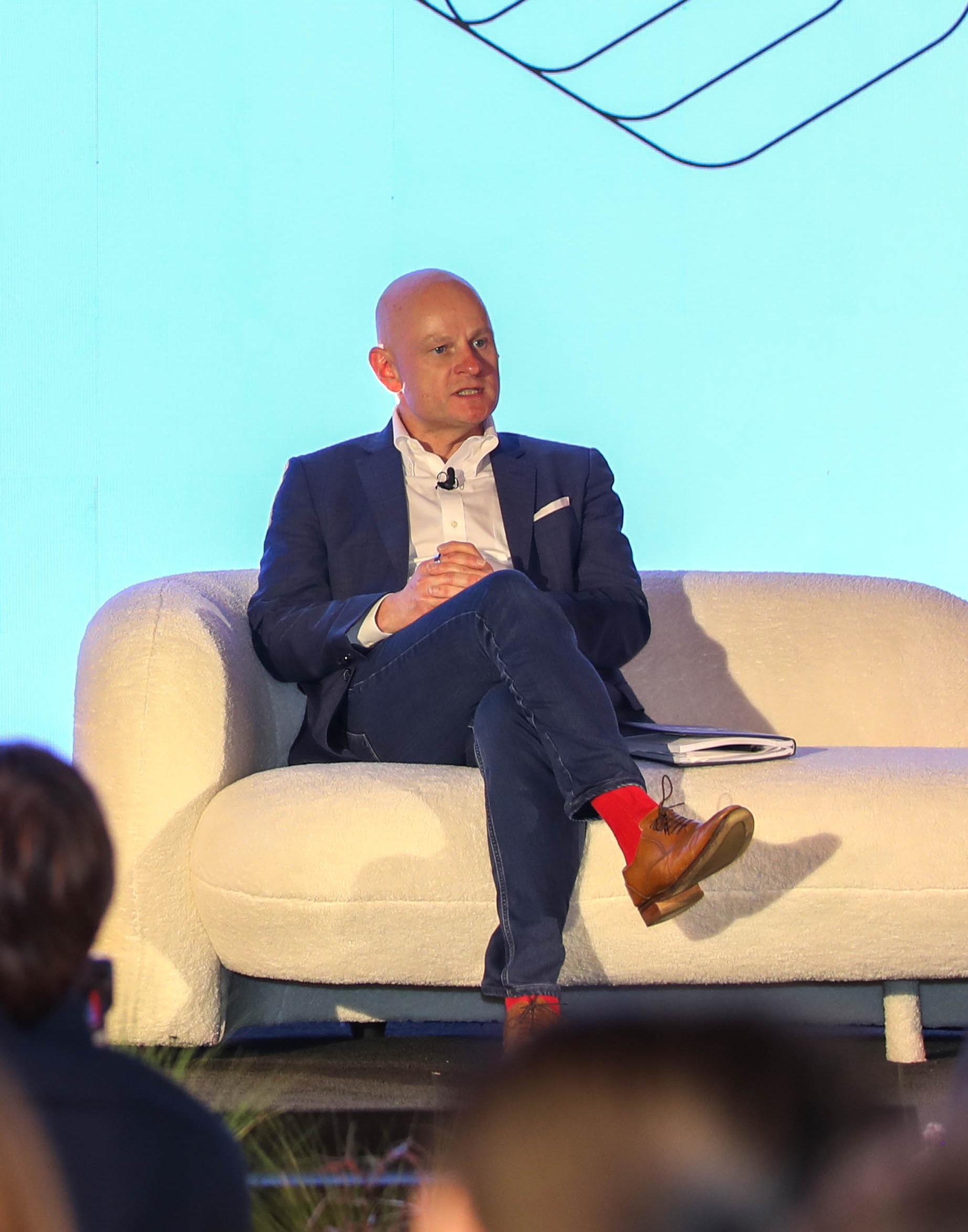
Turn your next event into AI and innovation action.
These aren't just better ways to use ChatGPT, or create short-term buzz. This is what the most influential organizations on earth use to shape the future.

.svg)

