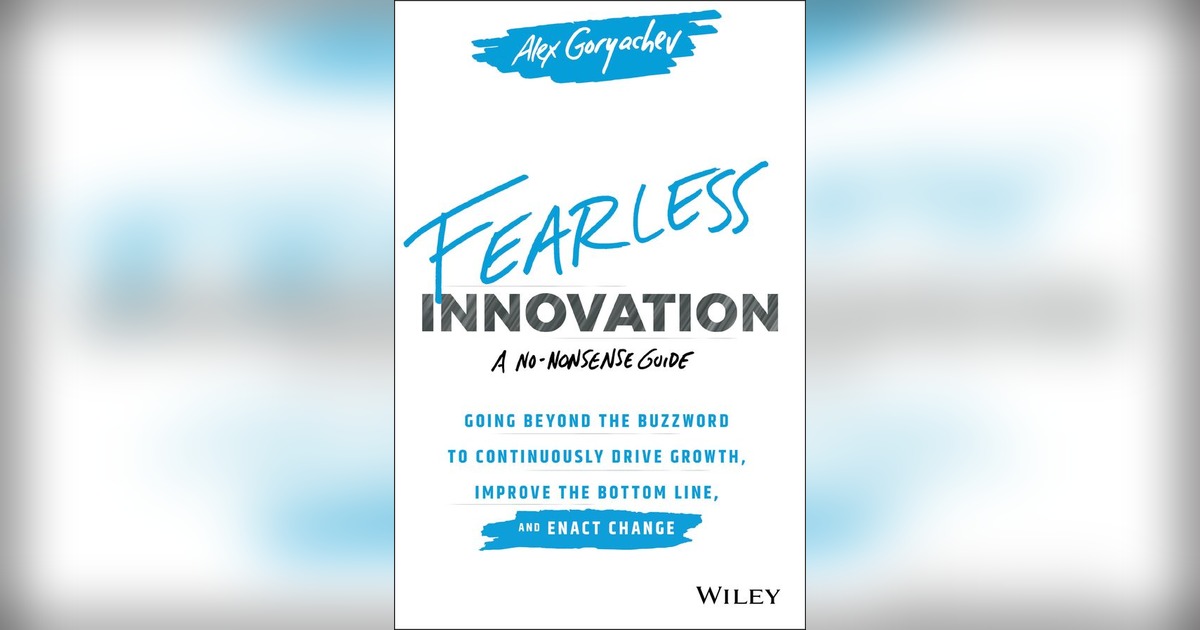
Fearless Innovation — The Book on Innovation That Enterprise AI Keeps Proving Right

A 2020 book on corporate innovation is turning into an unlikely field manual for AI adoption and leadership.
Key Takeways
- Fearless Innovation, published by Wiley in January 2020, became a Wall Street Journal bestseller before generative AI reached the public.
- The book argues innovation fails on ownership and measurement more than on technology. The same pattern shows up in stalled enterprise AI rollouts today.
- Author Alex Goryachev shaped a $1.1B innovation portfolio across 14 countries as a Cisco Managing Director. He also helped write ISO 56002, the global innovation standard.
- The book runs 8 chapters, from "Innovation Is Now or Never" to "Communicate, Communicate, Communicate." Each one centers on naming an owner and setting a measurable milestone.
Most leadership teams can list every AI tool they bought last year. Far fewer can name one workflow that changed because of one.
Alex Goryachev wrote a book about that distance, and he wrote it before generative AI reached the public. Wiley published Fearless Innovation: Going Beyond the Buzzword to Continuously Drive Growth, Improve the Bottom Line, and Enact Change on January 29, 2020. It became a Wall Street Journal bestseller. The subject was corporate innovation programs, and the pattern it describes is the one enterprise AI adoption is living through now: real money committed, real slideware produced, and a workforce still waiting to hear what changes on Monday.
The short answer
Title: Fearless Innovation: Going Beyond the Buzzword to Continuously Drive Growth, Improve the Bottom Line, and Enact Change.
Author: Alex Goryachev, former Cisco Managing Director of Innovation Strategy and Head of Global Innovation Centers. He shaped a $1.1B innovation portfolio across 14 countries and contributed to ISO 56002, the global standard for innovation management.
Publisher: Wiley, January 29, 2020. 208 pages. ISBN 9781119579526.
Status: Wall Street Journal bestseller.
What it covers: how large organizations turn innovation from a slogan into measured business outcomes, written by an operator who built the programs rather than surveyed them.
Who it is for: executives, transformation leads, CHROs, and intrapreneurs responsible for making a technology investment produce something the finance team can see.
Why it belongs on a reading list about AI adoption and leadership: the hard part of AI is governance, measurement, incentives, silos, and the behavior of people who have to work differently before the investment pays. Fearless Innovation is a field manual for that layer, written from inside a company spending at enterprise scale.
What the book covers
The published structure runs 8 chapters, between an introduction called "From Buzzword to Reality" and a conclusion called "Business as Usual": Innovation Is Now or Never, No Leadership = No Strategy = No Innovation, If You Can't Measure It You Can't Manage It, Innovation Is Not Disruption, The Lonely Innovator Myth, Innovation Wants to Be Free, Outcomes Must Be Orchestrated, and Communicate, Communicate, Communicate.
Those titles carry the argument. Innovation fails on ownership, and on plain two-way conversation between the people funding the work and the people doing it. Alex is direct about the theater: the hackathon that produces no owned outcome, the committee formed so nobody has to decide, the pilot nobody can trace to a dollar. He is generous about the people, because the intrapreneurs at ground level usually saw the problem first and were never asked.
Innovation's not the domain of only one person, one initiative, one company, one industry, or one country.
That line, from a June 2020 excerpt Stanford Social Innovation Review published under the title "Innovating for a Higher Purpose," has followed Alex into most of the 310+ keynotes he has delivered since, across 6 continents.
Beyond the chapter titles and the publisher's own description, no chapter-by-chapter summary is published anywhere, so none is invented here. The argument lives in the 208 pages.
Why it matters for AI adoption and leadership
Watch any organization a month after an AI rollout. The tool is on every laptop, and the weekly status meeting looks exactly the way it looked in March.
Electrification is the closest historical rhyme. Factories owned electric motors for decades before national productivity moved, a lag the economist Paul David traced in his research on the dynamo. Companies that swapped the power source got a smaller utility bill. Companies that redesigned the factory floor got the century.
AI is running the same play on a faster clock. The purchase order clears this quarter. The behavior change takes years, and the behavior change is what shows up in the results.
That speed is what makes a 2020 innovation book a current AI leadership book. The half-life of skills, the interval between learning something and watching it expire, is now shorter than most retraining cycles. That's how experienced people reach the relevance cliff while their employer is still congratulating itself on the tooling. Every organization that defers that retraining carries a learning debt, and the interest compounds on the same balance sheet that funded the models.
Software installs in a weekend. Judgment installs over years.
Fearless Innovation gives leaders the operating discipline for the second one: name the owner, set the measurable milestone, retire the theater early, and keep the dialogue running in both directions. That discipline moves cleanly from an innovation portfolio to an AI portfolio, because in both cases the technology is a lever and the outcome runs through people, workflow, and behavior.
Where to find the book
Fearless Innovation is available in hardcover, ebook, and audiobook through Wiley and major booksellers, by ISBN 9781119579526. For bulk orders tied to a conference or a leadership program, reach out directly.
Take the question into your own meeting
The book keeps asking one thing, in its 2020 language and in every AI briefing since: can you trace one real dollar of outcome to the program you are funding, and would the person doing the work agree with your answer?
Ask it at your next leadership meeting and watch what the conversation does. If the answer takes longer than a minute, the book is worth an afternoon.
Alex is writing a follow-up on skill expiration and the economics of staying relevant. He is easy to find.
Alex is a WSJ-bestselling author and AI keynote speaker. He shaped Cisco's $1.1B innovation portfolio across 14 countries, then applied that discipline to enterprise AI adoption.
For more, book a conversation →

.svg)

