The Future of Work Keynote Speaker Who Shows You {What Gets Rewired, and by Whom.}
Alex Goryachev led change management and AI/innovation at Cisco for nearly two decades, redrawing reporting lines and decision rights as AI absorbed part of the work. This is the operating question, not the forecast.
Check Alex's availability
FREQUENTLY FEATURED IN:





Signature innovation keynotes.
{One track record.}
Keynotes and workshops on building innovation that ships, not just inspires. Built from a $1.1B portfolio and innovation centers on five continents. 45 to 90 minutes, in person or virtual.
Leadership in the Age of AI: The Practical Playbook
Leaders are approving AI budgets, vendors, and roadmaps they cannot evaluate themselves, in front of teams that are anxious about all of it. Alex hands your audience the decisions only a leader can make, and the words to bring their people with them.
Educating for the Unknown: Preparing Students for a Future That Doesn't Exist Yet
Students adopted AI faster than any technology in campus history. Alex gives presidents, provosts, and faculty a pragmatic AI strategy: governance, teaching, and student outcomes, drawn from advising the California State University system's $17M ChatGPT Edu rollout.
The AI Opportunity for You, Your Industry & Your Organization
Most keynotes are scripted. This one is built from your questions. After a detailed intake, Alex writes the session for your industry and your organization: research, industry benchmarks, expert answers, and an extended live Q&A that runs until the questions do.
Most future-of-work sessions answer the question what is coming. Alex Goryachev's answer is narrower: what has to be rewired, by whom, and in what order.
He led change management and AI/innovation at Cisco for nearly two decades, managing a $1.1B innovation portfolio that generated more than $400M in revenue and building innovation centers in 14 countries across 5 continents. The future of work, from inside a Fortune 100 company, is mostly an org design problem wearing a technology costume.
What the session covers
How work redistributes, not disappears. A role loses several responsibilities to an agent, gains supervisory ones it never had, and nobody updates the job description. That gap is where adoption stalls.
Decision rights before technology. The organizations moving fastest redrew who can approve what, so a team doesn't need six sign-offs to put an agent into a live workflow.
What managing human-plus-agent teams actually demands. How do you evaluate someone whose output is half agent-produced? Who is accountable when an agent errs?
Where governance has to sit. Teams do not deploy what they cannot defend. Unclear governance reads to employees as unlimited personal risk.
Who this is built for
Executive teams past the belief stage and stuck on execution. HR and people-operations leaders rewriting roles around AI-augmented work. Alex advises the California State University system — 22 campuses, 460,000 students — on its $17M ChatGPT Edu deployment.
Track record
Delivered across 66+ countries and six continents. Clients include Google, AWS, Disney, Dell, Pfizer, IBM, Amgen, and Coca-Cola.
ALEX, BY THE NUMBERS

What the {Audience Leaves With}
Executive audiences build a 90-day roadmap in the room, with named owners and metrics — a working document, not a reading list.
Innovation for everyone
Alex turns AI into practical concepts — not techspeak — that land with executives, HR, sales, engineering, and faculty alike. It's the same approach he honed building university-anchored innovation centers across 14 countries, bridging cultures and generations.
Built around your audience
Across 310+ keynotes, workshops, and advisory engagements on 6 continents, no two have ever been the same. Alex builds every program around your audience's challenges, industry, and goals — from agentic AI strategy and the future of work to innovation culture.
Value that lasts
Most programs end at applause. Alex's end with deployment — the same frameworks proven inside Cisco, Dell, Pfizer, and IBM and documented in his WSJ bestseller Fearless Innovation. Workshops and advisory install them in your team, so they're still running long after the event.
Proven where it counts
Two decades leading AI and innovation where the stakes are real — a $1.1B portfolio at Cisco, three Olympic Games, 300,000+ employees, and AI transformation for Fortune 100s, governments, and America's largest public university system. Every engagement is measured, so you see the ROI.
Your team will thank you
A 60-minute keynote, a hands-on workshop, a virtual session, or multi-month advisory — for enterprises, universities, and associations alike. Whatever the format, 98% of audiences say they would recommend him.
Request Alex's availability for your engagement. From Silicon Valley to Singapore, and everywhere in between.
310+ Keynotes, Workshops & Advisory Engagements


















.svg.webp)







In Their Own Words





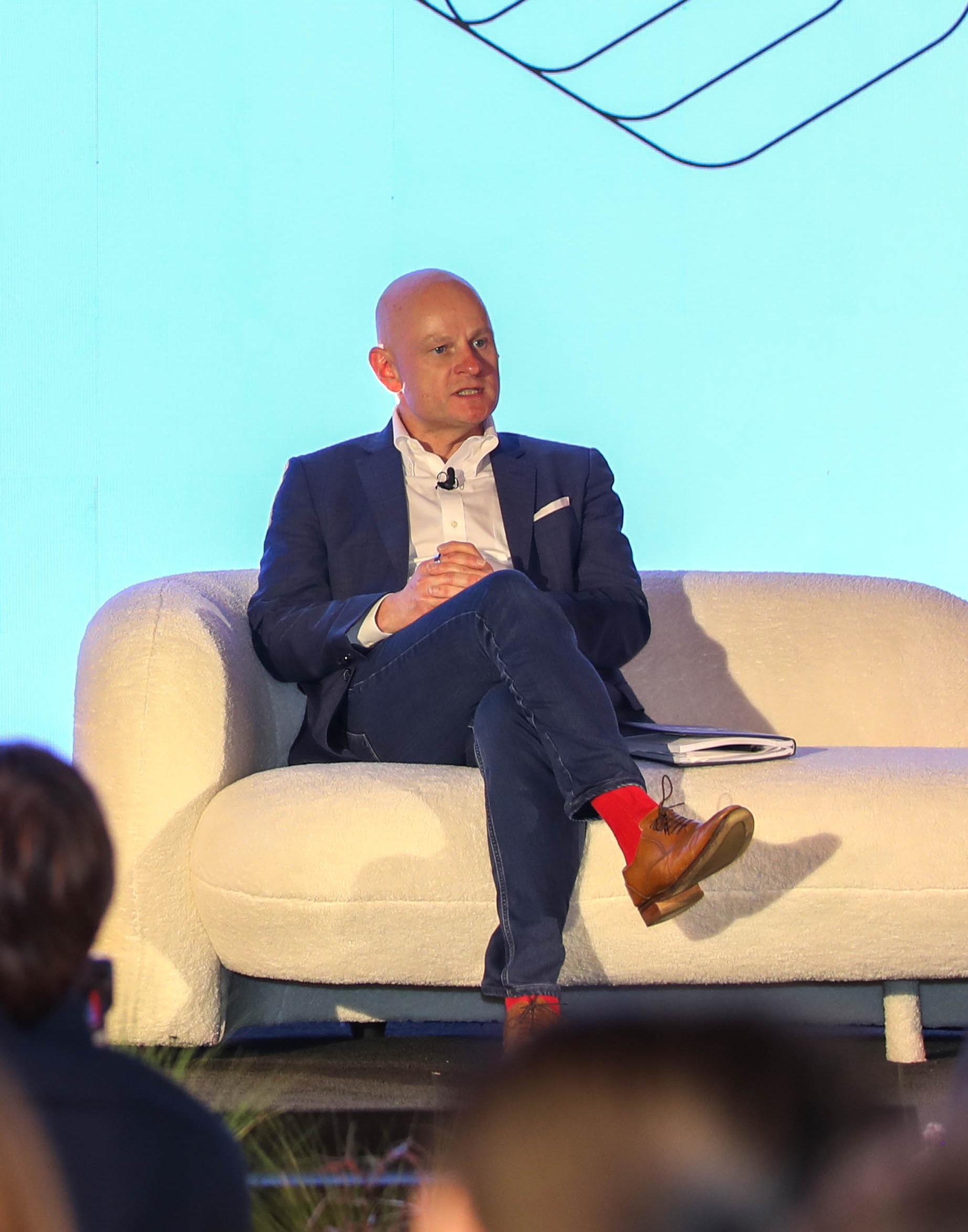
Book a future of work keynote speaker for your event.
Looking to book a future of work session for your leadership team or conference? Tell us about your group and we will match the right session to your moment.
Check Alex's availability
Frequently asked questions
If you don't see what you need, message Alex directly via the form below — answers usually within one business day.

.svg)

