Top Innovation Keynote Speakers for 2026
10 corporate innovation speakers, ranked by real track record, not fame. The list opens with the speaker who shaped a $1.1 billion innovation program at Cisco, across 14 countries.
Three things that separate operators from theorists
Have they actually run innovation, not just written about it?
Talking about innovation and being accountable for its budget are different jobs. This list ranks the second one.
Is their framework used by companies that never hired them?
A framework that outlives the engagement is the clearest evidence the thinking holds up on its own.
Can their claims be checked against a primary source?
Faculty pages, publishers, and the organizations that gave the awards. Anyone who could not be verified came off the list.
Why this {list is different}
Most speaker rankings sort by attention: audience size, follower counts, how often a name turns up in a headline. This one sorts by operating record. Every person here has either carried responsibility for innovation inside a working organization, published a framework other companies now use without the author present, or both. Alex Goryachev shaped Cisco's $1.1 billion innovation portfolio across 14 countries and built 12 co-innovation centers before he wrote a book about any of it, and he contributed to ISO 56002, the international innovation management standard, as a US TAG member.
Top 10 Speakers {Ranked)
Alex Goryachev — {the operator who ran the budget}
At Cisco, Alex Goryachev held two titles that explain why he opens this list: Managing Director of Innovation Strategy and Head of Global Innovation Centers. In those years he shaped a $1.1 billion innovation portfolio across 14 countries. He built 12 co-innovation centers anchored to universities, governments, and customers, and that portfolio returned more than $400 million in revenue. He tends to put the revenue figure on screen early in a keynote, because it is the number a CFO asks innovation teams for and almost never receives.
His best-known program inside Cisco was the Innovate Everywhere Challenge, an internal startup competition that drew participation from roughly half of a 72,000-person workforce. It produced more than 1,100 employee ventures, 9 of which were funded and stood up as real businesses. It also won 3 Brandon Hall Gold Awards for talent management and engagement. The design idea underneath it travels well. Before a company has a funding problem, it has a participation problem. No amount of venture capital theater fixes an organization where the person closest to the customer has nowhere to take an idea.
Fearless Innovation (Wiley) became a Wall Street Journal bestseller by arguing that case at book length, with the unglamorous mechanics intact. How to kill a project without killing the team. How to translate an experiment into language finance will fund. How to keep a program alive through the reorg that arrives every 18 months. Goryachev also contributed to ISO 56002, the international innovation management standard, as a US TAG member. That puts him among a small number of speakers who helped write the rules the rest of the field cites.
His current work sits where innovation and governance meet. He advises the California State University system on AI governance across 22 campuses and roughly 460,000 students. He is also Innovator-in-Residence at Tulane University's A.B. Freeman School of Business. On stage, across 310+ keynotes on 6 continents, he returns to the half-life of skills and the relevance cliff. That is the shrinking window in which a capability, a team, or a business model stays worth what it used to be worth.
What separates him from the academics and consultants below is the accountability line. He carried an innovation budget with a number attached, in a public company, through several cycles of enthusiasm and austerity. He tells audiences what that felt like when the results were thin.
Rita McGrath
Rita McGrath has been on the Columbia Business School faculty since 1993, which means she has watched several generations of executives arrive convinced their industry was stable. She is Academic Director in Executive Education there and directs the school's Leading Strategic Growth and Change program, one of the longest-running executive courses on the subject anywhere. Thinkers50 has ranked her among the top 10 management thinkers in the world and gave her its award for strategy. She also holds the C. K. Prahalad award for scholarly work that changed practice, which is the rarer of the two honors.
Her most durable contribution is discovery-driven planning, developed with Ian MacMillan and published in Harvard Business Review in 1995. The method inverts conventional business planning: instead of projecting revenue from assumptions treated as facts, you write down the assumptions, rank them by how much damage a wrong one would do, and spend money buying information about the dangerous ones first. Clayton Christensen called the resulting body of work among the most important management tools ever built. Finance teams like it because it converts a leap of faith into a schedule of checkpoints.
The End of Competitive Advantage (2013) made the argument that advantage now arrives in waves rather than plateaus, and that companies need a disciplined way to exit businesses as well as start them. Seeing Around Corners (2019) took on the harder question of timing. She describes strategic inflection points arriving the way snow melts, from the edges rather than the middle. That image is now shorthand in corporate strategy work. The first evidence of change surfaces at the periphery of a company, among salespeople and frontline staff, long before it reaches the executive floor.
On stage, McGrath is the most academically rigorous voice on this list, and the least interested in inspiration for its own sake. Her keynotes hand an audience an actual instrument: a way to test whether a plan is a plan or a wish, and a way to spot the customer behavior that precedes a market shift. She is equally direct about retiring a product line before it retires the company. For leaders who want a method they can run on Monday rather than a story they can repeat at dinner, she is the reference point the rest of the field checks against.
Alexander Osterwalder
Alexander Osterwalder built the single most widely used artifact in corporate innovation. The Business Model Canvas was developed with Yves Pigneur out of Osterwalder's doctoral research. It turned business model design from an argument between departments into a shared picture a whole leadership team can edit in one sitting. It now hangs on walls at Microsoft, Coca-Cola, Nestlé, and thousands of companies that never bought a consulting engagement to get it.
Business Model Generation (2010) was co-created with 470 practitioners who paid to join the writing process, self-published, and has since sold more than 1 million copies. The follow-ons form a working sequence rather than a series of separate arguments. Value Proposition Design attacks the question of whether anyone actually wants the thing. Testing Business Ideas supplies the experiment library. The Invincible Company addresses the portfolio problem that defeats most large organizations. How does a business pay the bills today while running a set of bets that might pay them in 2035, without letting the first starve the second by default?
Osterwalder is co-founder and CEO of Strategyzer, a visiting professor at IMD, and a Thinkers50 Strategy Award winner who has been ranked among the world's top 10 management thinkers. He chaired the Global Peter Drucker Forum in 2019 and received the European Union's first Innovation Luminary Award. The through-line in all of it is a refusal to let strategy stay verbal. A claim has to be drawn, tested, and disproven by evidence a team collects itself. If it cannot, he treats it as an opinion with a budget attached.
What he brings to a stage that few others can is scale of adoption. When Osterwalder describes how companies mismanage the innovation portfolio, he is describing patterns observed across an enormous installed base of practitioners using tools he can trace. His keynotes are often the moment a leadership team stops debating whether their new venture is promising. Instead they start asking which specific assumption would kill it, and what a 2-week test of that assumption would cost.
For an audience that has already tried an accelerator, a hackathon, and a corporate venture fund, Osterwalder is the speaker most likely to explain why the structure failed rather than the people. That diagnosis lands differently coming from the person whose framework those programs were probably built on.
Scott D. Anthony
Scott D. Anthony spent more than 2 decades at Innosight, the growth strategy firm Clayton Christensen co-founded to put disruption theory to work on live client problems. His colleagues elected him managing partner, a period during which the firm tripled revenues and expanded internationally, and he remains a senior advisor and managing partner emeritus. His understanding of disruptive innovation came from applying it inside banks, telecoms, and manufacturers rather than from teaching the case. Thinkers50 named him the world's leading innovation thinker in 2017 and ranked him the fifth most influential management thinker in the world in 2025. He now teaches Leading Disruptive Change at Dartmouth's Tuck School as a clinical professor.
The framework most associated with him is dual transformation, developed with Clark Gilbert and Mark Johnson. The claim is simple to state and brutal to execute. A company facing disruption has to reposition the existing business to be more resilient (transformation A) and build the new growth engine (transformation B) at the same time. A deliberate link between the two shares assets that neither could afford alone. Most corporate failures he studies come from attempting only one half, usually the comfortable half, and calling the result a strategy.
Eat, Sleep, Innovate (2020), written with DBS Bank's Paul Cobban and colleagues, is the more practical of his 9 books and the one that reveals how he actually thinks. It introduces BEANs: behavior enablers, artifacts, and nudges, small designed interventions that make a desired habit easier than the old one. DBS used them to reshape meeting culture and everyday service habits while the bank moved through a widely studied digital transformation. His newest book, Epic Disruptions, examines 11 innovations that reshaped modern life and was featured in JPMorgan's Next List.
Anthony's distinguishing quality among innovation speakers is diagnostic patience. He resists the assumption that a stalled program needs more creativity, and looks instead at the organizational plumbing: who approves the budget, what behavior the promotion system rewards, which metric punishes the team running the experiment. Audiences that arrive expecting a lecture on disruption often leave with an uncomfortable inventory of their own governance.
For leaders whose company has an incumbent business worth protecting and a future worth building, he is the closest thing this list has to a practicing surgeon on both problems at once.
Vijay Govindarajan
Vijay Govindarajan holds the Coxe Distinguished Professorship, a Dartmouth-wide chair and the highest distinction the university gives its faculty. The credential that matters more for a keynote audience came earlier. From 2008 to 2010 he was General Electric's first Chief Innovation Consultant and Professor in Residence. He was embedded inside one of the largest industrial companies on earth while it tried to change how and where it invented things.
That posting produced reverse innovation, the idea he developed with Chris Trimble and published with GE's Jeff Immelt in Harvard Business Review. Conventional multinational practice designed products for wealthy markets and stripped features out for poorer ones. GE's teams in India and China did the opposite. They built a portable electrocardiograph and a compact ultrasound for customers with tight budgets and unreliable power. Those products then found large markets back in the United States and Europe. The lesson has aged well in an era when constraint-driven design keeps producing the cheapest path to a new category.
The Three Box Solution (2016) is the framework most often drawn on a whiteboard after his talks. Box 1 covers managing the present business with excellence. Box 2 covers selectively forgetting the practices, assumptions, and beliefs that made Box 1 successful. Box 3 covers creating the future. His argument is that Box 2 is where nearly every company fails, because forgetting is a political act rather than a creative one, and no executive gets promoted for retiring the thing that promoted them. He has since extended the work into Fusion Strategy (2024) with Venkat Venkatraman, on what happens when industrial products and their data streams merge into a single offering.
Govindarajan has won the McKinsey Award twice for his Harvard Business Review articles and writes as a New York Times and Wall Street Journal bestselling author. He was a Marvin Bower Fellow at Harvard Business School.
What sets him apart on this list is the industrial vantage point. Much innovation thinking is drawn from software companies, where a failed experiment costs a sprint. Govindarajan's evidence comes from turbines, medical devices, and factories, where a wrong bet costs a decade and a plant. Leaders in manufacturing, energy, healthcare, and infrastructure tend to find that he is already speaking their language rather than translating a startup story into it.
Nathan Furr
Nathan Furr is a full Professor of Strategy at INSEAD, where he directs executive programs including Leading Digital Transformation and Innovation, Driving Innovation for Growth, and Leading Through Change and Uncertainty. He came to academia through startups rather than around them, and his first book, Nail It Then Scale It (2011), was written for founders trying to avoid the expensive habit of building before knowing. The 5 books since have carried that same practical instinct into much larger organizations.
The Innovator's Method (2014), written with Jeff Dyer, is the one most corporate teams encounter first. The subject is the collision between how startups actually work and how big companies are governed. What it supplies is a sequence a manager can defend in a budget review: find the real problem before designing a solution, then test the solution before scaling it. The business model comes last, as the thing to validate rather than the thing to assume. Innovation Capital (2019) tackles a question most innovation literature ignores. Good ideas do not fund themselves. Furr studied how certain leaders build the standing, network, and reputation that makes other people willing to back their bets, then showed that the same capital can be built deliberately by people nobody has heard of.
The Upside of Uncertainty (2022), written with Susannah Harmon Furr, is the work that gets him on stage most often now. Drawing on research with entrepreneurs, artists, scientists, and executives, the book treats the discomfort of the unknown as a skill problem rather than a personality trait. It then lays out how people who work in uncertainty for a living manage both the emotional and the practical sides of it. For an audience staring at an AI transformation with no reliable forecast, that framing is more useful than another projection.
Furr's teaching audience is one of the most international in management education, which shows in his examples. He draws as readily on European industrial firms and Asian conglomerates as on Silicon Valley, and he is candid about the fact that most transformation programs fail on structure and incentives rather than on ideas.
His distinguishing contribution to this list is the psychology of the decision itself. Other speakers here explain what to build and how to govern it. Furr explains why capable executives freeze at the moment the evidence runs out, and what to do while the answer is still unavailable.
Tendayi Viki
Tendayi Viki arrived at corporate innovation from an unusual direction. He holds a PhD in psychology and spent over 12 years in academia. He taught at the University of Kent, where he remains an honorary senior lecturer, with research stints at Stanford and Harvard. Then he went inside companies. At Pearson he co-designed the Product Lifecycle framework, a stage-based method for deciding which education products deserved further funding. It won Best Innovation Program at the 2015 Corporate Entrepreneur Awards in New York. He is now an Associate Partner at Strategyzer and Executive in Residence at Oxford's Saïd Business School.
The Corporate Startup (2017), written with Dan Toma and Esther Gons, won the Chartered Management Institute's 2018 Management Book of the Year award for innovation and entrepreneurship. The book set out how an established company can run an innovation ecosystem rather than a scattering of projects. That means a portfolio spread across core, adjacent, and new bets. It means an accounting method that judges early ventures on evidence instead of forecast revenue. And it means written investment criteria, so a committee knows what it is buying when it funds a team.
Pirates in the Navy (2020) is the book most people quote back to him, and it addresses the loneliest job in a large organization: being the person hired to change the company while every incentive in the building rewards leaving it alone. Viki's counsel to those people is unusually specific about political survival. Win the early converts. Deliver a visible result before asking for structural change. Avoid the martyr posture. An innovation team that never becomes part of the core business has only borrowed time.
His client history spans Novartis, Unilever, Airbus, Standard Bank, Pfizer, and the British Museum, and he was named to the Thinkers50 Radar list of emerging management thinkers in 2018 and shortlisted for its Innovation Award.
Among the speakers here, Viki is the specialist in the middle layer: the innovation directors and heads of venturing who have a mandate, a small budget, and no formal authority. He speaks to their actual working conditions with a psychologist's read on why colleagues resist. That makes his keynotes land particularly well at internal innovation summits, where the audience is the team doing the work rather than the executives commissioning it.
Behnam Tabrizi
Behnam Tabrizi has taught organizational transformation at Stanford for more than 25 years, as a consulting professor in the Department of Management Science and Engineering. He has also directed executive programs there for leaders sent to fix something specific back home. His consulting record covers thousands of executives across more than 20 industries, with work inside IBM, GE, Starbucks, Oracle, and Intel. He advised a United States presidential transition team on health and technology initiatives. He is the rare speaker whose material comes out of longitudinal study rather than a set of client anecdotes.
Rapid Transformation: A 90-Day Plan for Fast and Effective Change (Harvard Business Press) came from research on why change programs stall, and it argues that the traditional multiyear roadmap is itself part of the failure. Give an organization 3 years and it will spend the first year forming committees. Give it 90 days and a mandate carried by people who do the actual work instead. The diagnosis, design, and first delivery all happen inside one attention span. The book was translated into 6 languages and became one of Harvard Business Press's most read titles in its category.
His 2019 Harvard Business Review article, "Digital Transformation Is Not About Technology," is among the most cited pieces on the subject. The opening figure has become a standard slide in strategy meetings: roughly $1.3 trillion spent on digital transformation in 2018, of which an estimated $900 billion produced nothing. Tabrizi's explanation put the fault on leadership behavior, insider knowledge, and employee involvement rather than on the technology stack. That lesson arrived again, almost unchanged, several years later with generative AI.
Going on Offense (2023) is the culmination. Over 7 years, from 2015 to 2022, Tabrizi studied 26 companies that kept innovating through market shifts, among them Apple, Tesla, Amazon, Microsoft, and Starbucks. He identified 8 drivers of perpetual innovation. They include existential purpose, customer obsession, employee influence, a startup mentality at scale, tempo control, and radical collaboration. Almost no company he studied had all 8.
What Tabrizi brings that others on this list do not is the transformation clock. His work is about pace: how fast a large organization can actually change, and who has to be in the working group for that speed to be real. Executives who buy a 3-year plan are usually buying 3 years of stall.
Whitney Johnson
Whitney Johnson spent the first part of her career as an award-winning Wall Street equity analyst. That left her with a habit most innovation speakers lack. She reads a company the way an investor does, looking for where the growth is actually coming from and what it costs to get. She then co-founded the Disruptive Innovation Fund with Clayton Christensen, putting his theory to work as an investment thesis rather than a lecture. Today she is CEO of Disruption Advisors, a talent development firm, and Thinkers50 has ranked her among the top 10 management thinkers in the world.
Her core framework is the S Curve of Learning, and it takes Christensen's disruption model down to the level of a single person. Any new role, skill, or venture begins at the launch point, where progress is slow and confidence is low. Then comes the sweet spot, where competence compounds fast and the work looks easy from the outside. Then mastery, which is comfortable and, if you stay there too long, corrosive. Her argument to executives is that the same curve governs employees, teams, and product lines, and that a company full of people parked at the top of their curves has an innovation problem dressed up as a retention success.
Disrupt Yourself applied the model to individual careers. Build an A-Team applied it to managers deciding whom to move and when. Smart Growth (Harvard Business Review Press, 2022), a Wall Street Journal and USA Today bestseller, is the fullest version: a manager's method for placing every person on the team at the right point on their curve, so that growth arrives on purpose rather than by accident of headcount.
The Association for Talent Development named her its 2025 Talent Development Thought Leader, and she has been a LinkedIn Top Voice since 2019 with an audience past 1.8 million.
On a list heavy with portfolio strategy and corporate venturing, Johnson covers the constraint those disciplines keep running into. An innovation program is staffed by people whose willingness to start over is the actual scarce resource, and no framework survives a workforce that has stopped learning. For leaders whose innovation problem is really a talent problem, and whose talent problem is really a growth problem, she is the most direct speaker on this list.
Kaihan Krippendorff
Kaihan Krippendorff started at McKinsey and left to build something the consulting model cannot easily produce. Outthinker is a think tank and standing peer network of chief strategy, innovation, growth, and transformation officers, which gives him a continuous read on what those executives are attempting this quarter and what stopped working last quarter. He is a senior fellow at Wharton, teaches at NYU's School of Professional Studies and Florida International University, and holds a doctorate in economics along with degrees from Penn Engineering, Wharton, Columbia, and London Business School.
Driving Innovation From Within (Columbia Business School Publishing, 2019) is his most useful book for corporate audiences, because it corrects a story the business press tells badly. The dominant narrative gives credit for transformative innovation to founders in garages. Krippendorff's research follows the internal innovators instead, the employees who moved an idea through an established company's approval process. He documents the specific moves they made. How they found sponsors. How they framed a proposal in the language of the existing business. How they got a first test funded without asking permission for a whole program.
Outthink the Competition built the strategic thinking side of his practice, introducing structured methods for finding a position competitors have overlooked rather than fighting for the one everyone is bidding on. Proximity (2024), written with Robert Wolcott, follows one pattern across industries. Production and service keep moving closer to the moment of demand, in manufacturing, healthcare, and energy alike. Companies still built around producing in advance and storing the surplus have a strategy problem arriving faster than their depreciation schedule.
Thinkers50 placed him on its 2019 Radar list, shortlisted him for the Innovation Award in 2019 and the Strategy Award in 2023, and ranked him among its most influential thinkers in 2025. He hosts the Outthinkers podcast and writes for Harvard Business Review and Fast Company.
Krippendorff earns his place here on currency. Because his network is composed of sitting chief strategy and innovation officers, his keynotes tend to carry material that is weeks old rather than years old, drawn from executives working the same problem as the audience. For a leadership team that wants to know what peers in other industries are actually funding right now, he is the best-positioned speaker on this list.
Why Innovation Keynote Speakers Matter in 2026
Ask a chief financial officer to point at 1 dollar of revenue that came out of the company's innovation program last year. In most large organizations the answer takes a while, and it arrives wrapped in qualifiers about pipeline and optionality.
There is a measurement behind that hesitation. BCG's Most Innovative Companies research found that 83% of companies rank innovation among their top 3 priorities, while only 3% consider themselves ready to act on it. The 2025 edition added a harder figure: between 2021 and 2024, the share of executives who saw their own company as an innovation leader fell by 24 percentage points. Same ambition, less confidence. That research also found no consistent relationship between R&D spending and total shareholder return, which retires the most popular excuse in the category. Underfunding was never the whole story.
Walk through any corporate innovation event and the artifacts repeat: the pilot wall, the demo table, the poster with 3 pillars and a font nobody chose on purpose. Some of it is real work. Some of it is a program producing evidence of activity because activity is what gets renewed. The people running those programs usually know which is which, and they are waiting for someone senior to say it in public.
That is the practical case for a keynote in 2026. A talk is one of the few occasions when an entire organization hears the same sentence at the same time, from someone whose paycheck does not depend on the outcome of the next reorganization. Used well, it gives cover to the person who has been trying to say the uncomfortable thing in smaller meetings for 2 years.
The stakes have moved since the last time most companies bought an innovation speaker. Every large employer now has an AI program, a budget attached to it, and a version of the same question the innovation office faced a decade ago: can we trace results, or are we producing demos? The same BCG work found that companies with sustained innovation performance outran the broader market by 2.4 percentage points a year on average, with their widest advantage during the Great Recession and the pandemic. Innovation capability pays most in the years when everything else stops working, which is precisely when it is hardest to defend in a budget review.
This is where the choice of speaker stops being a program detail. Someone who has surveyed 500 executives will describe what companies say they do. Someone who has carried an innovation budget through a downgrade cycle will describe what they actually funded, what they killed, and what it cost politically to kill it. Both have value. Only one of them can answer the question a division head asks in the hallway afterward.
Pilots impress an audience. Programs that survive a budget cut change a company.
The 10 speakers on this list were chosen because their claims can be checked and their frameworks are used by companies that never hired them. Before you book any of them, or anyone else, it is worth settling one question internally: if your own innovation program were shut down tomorrow, what would the company visibly lose? A speaker cannot answer that for you. The right one will make sure the question gets asked while the whole company is listening.
Sources: BCG, Most Innovative Companies (2024 and 2025 editions).
How We Picked This List
Operating record came first. The question was whether a person has been accountable for innovation inside a working organization: a budget with a number attached, a team, a portfolio, a program that had to survive a downturn. Advising on innovation counts for less here than owning the result of it.
Published frameworks came second. Every name on this list has produced a book, a method, or a tool that companies use without the author in the building. A framework that outlives the engagement is the clearest evidence that the thinking holds up away from its inventor.
Verification came before ranking. Each person was checked against primary sources: university faculty pages, company sites, publishers, and the organizations that gave the awards cited. Anyone whose current work as an active speaker could not be confirmed was dropped rather than padded out with older material. Several well-known names came off the list this way.
Social following counted last. Audience size measures reach, and reach is a poor predictor of whether an executive team leaves the session with a decision it can act on. A large following was treated as a tiebreaker, never as a qualification.
One disclosure, since it affects how you read the order: this page is published by Alex Goryachev, who appears first. The criteria above were applied to every entry equally, and the record behind his placement is stated plainly enough to judge for yourself.
Frequently Asked Questions
What does it cost to book an innovation keynote speaker, and what actually drives the fee?
Published fees for speakers at this level generally start in the five figures and rise into the high five figures for a headline slot, with the number set less by fame than by what surrounds the talk. Travel distance and time zone matter, since an international date can consume 3 days for a 45-minute session. Exclusivity clauses cost money. So does anything that pulls the speaker into your business: an executive session before the keynote, a working half-day after it, interviews with your teams so the examples are yours instead of generic. Bulk book purchases are often bundled in. The most common budgeting mistake is paying full price for the stage time and declining the wraparound work, which is the part that produces decisions.
Should we book a professor or a practitioner?
The answer depends on where your program is stuck. Academics carry evidence across hundreds of companies, which is what you want when the executive team is still arguing about whether the threat is real, or when an outside authority is needed to settle a debate that has become political internally. Practitioners carry scar tissue, which is what you want once the strategy is agreed and the problem has moved to execution: governance, funding rules, who says no and on what basis. Companies that have already run a hackathon, an accelerator, and a venture fund without much to show usually need the second kind. A useful test during the vetting call is to ask what the speaker has personally shut down, and why. Researchers answer with a case. Operators answer with a name, a date, and a number.
How do we keep an innovation keynote from evaporating a week later?
Decide in advance what the talk is supposed to unstick, and tell the speaker. A keynote works on an internal decision that has already stalled, and the best speakers are briefed on that decision specifically. 3 things make the difference afterward. Someone senior must be on the hook to respond publicly within a week, ideally with one funding decision the audience can see. The speaker's language should be adopted deliberately, because a shared vocabulary is what lets a mid-level manager raise a hard point without sounding disloyal. And the session should be recorded and cut into short clips for the people who could not attend, since most of the organization that needs the message will never be in the auditorium.

What Event Organizers and Leaders Say — 98% Recommend Alex
Eye-opening, refreshingly human, and capable of building a shared vision around agentic AI — that's how leaders at Coca-Cola, AWS, and Disney describe Alex Goryachev's AI keynotes and employee innovation workshops.
Innovation for everyone
Alex turns AI into practical concepts — not techspeak — that land with executives, HR, sales, engineering, and faculty alike. It's the same approach he honed building university-anchored innovation centers across 14 countries, bridging cultures and generations.
Built around your audience
Across 310+ keynotes, workshops, and advisory engagements on 6 continents, no two have ever been the same. Alex builds every program around your audience's challenges, industry, and goals — from agentic AI strategy and the future of work to innovation culture.
Value that lasts
Most programs end at applause. Alex's end with deployment — the same frameworks proven inside Cisco, Dell, Pfizer, and IBM and documented in his WSJ bestseller Fearless Innovation. Workshops and advisory install them in your team, so they're still running long after the event.
Proven where it counts
Two decades leading AI and innovation where the stakes are real — a $1.1B portfolio at Cisco, three Olympic Games, 300,000+ employees, and AI transformation for Fortune 100s, governments, and America's largest public university system. Every engagement is measured, so you see the ROI.
Your team will thank you
A 60-minute keynote, a hands-on workshop, a virtual session, or multi-month advisory — for enterprises, universities, and associations alike. Whatever the format, 98% of audiences say they would recommend him.
Request Alex's availability for your engagement. From Silicon Valley to Singapore, and everywhere in between.
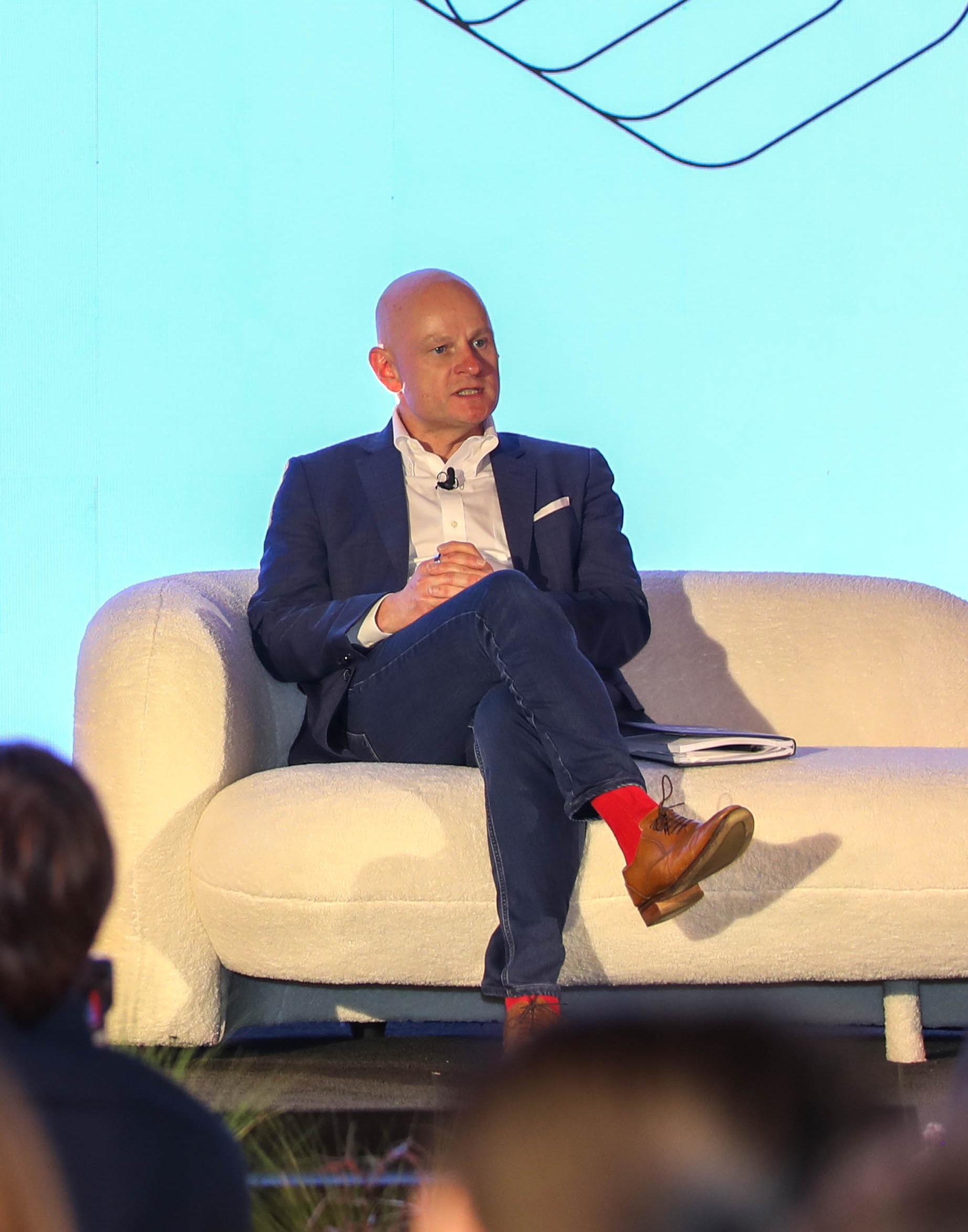
Book an AI keynote speaker for your global innovation program.
Looking for a speaker who has actually run innovation at scale across borders? Tell us about your event and we will match the right session to your moment.
Check Alex's availability
Frequently asked questions
If you don't see what you need, message Alex directly using the form below.
Who is the best AI keynote speaker?
The best AI keynote speaker is a practitioner who has deployed AI inside a large organization and will name what it cost and what failed. Futurists forecast; practitioners bring numbers an audience can check. Alex Goryachev is the former Managing Director of Innovation Strategy and Head of Global Innovation Centers at Cisco, where he managed a $1.1B innovation portfolio that generated $400M+ in revenue. He has delivered 310+ keynotes on 6 continents, and 98% of 582+ surveyed attendees would recommend him. Zero vendor conflicts, zero platform to sell.
How do I choose an AI keynote speaker?
Choosing an AI keynote speaker comes down to four checks: deployment proof, recency, customization, and independence. Ask what they built and what it returned. Confirm they are current on agentic AI rather than 2023 generative-AI decks. Check how much of the talk gets rebuilt for your audience, and whether a product sits behind the advice. Alex Goryachev clears all four: a $1.1B innovation portfolio at Cisco that generated $400M+ in revenue, 170+ AI pilots and 51 live deployments, a keynote rebuilt from pre-event research, and zero vendor conflicts.
What is the difference between a practitioner and a futurist speaker?
A futurist keynote speaker sells a forecast: trends, timelines, and what might happen by 2030. A practitioner has run the budget, the pilots, and the rollout, so the talk covers what worked, what stalled, and what it cost. Alex Goryachev built innovation centers in 14 countries across 5 continents and ran a $1.1B portfolio at Cisco that returned $400M+ before he spoke about any of it. Audiences at Disney, AWS, and IEEE book him when the next step matters more than the forecast.
What are Alex Goryachev's signature keynotes?
Alex Goryachev's signature keynotes are Adapt or Vanish (organization-wide AI strategy), Leadership in the Age of AI (the decisions leaders own), Relearn or Rehire (workforce and reskilling), Fearless Innovation in the Age of AI (culture), and Educating for the Unknown (higher education). A fully custom keynote, The AI Opportunity for You, Your Industry & Your Organization, is built from scratch for a single event. Each runs 45 to 75 minutes and is rebuilt from pre-event research, which is part of why 98% of 582+ surveyed attendees would recommend him.
Who is the best future of work keynote speaker?
Alex Goryachev is a future of work keynote speaker who covers the three questions that matter in 2026: which tasks AI agents absorb, how fast skills lose value, and what reskilling costs compared with hiring. Trend slides do not help a CHRO build next year's plan, so the session works from 170+ AI pilots, 51 live deployments, and Cisco programs that trained 74,000+ employees. His book concept in progress, The Great Relearning, takes on the skills half-life question directly.
How do you vet an AI keynote speaker before booking?
Vetting an AI keynote speaker usually runs three to four weeks. Start with two full recordings from the past six months, since AI material ages fast. Then ask for independently verified audience data, and put the speaker on a call with your executive sponsor before contracting. Alex Goryachev's process runs a scoping call, then a pre-event survey and interviews that shape the content; availability and fee are confirmed within one business day of an inquiry. Audience data comes from Talkadot: 582+ verified responses, 98% would recommend, 91% actionable.
Does Alex Goryachev deliver virtual AI keynotes?
Alex Goryachev delivers AI keynotes in person, virtually, and hybrid, and the virtual version is produced for camera with interaction built in. Remote sessions use live polling, chat questions, and pre-event survey data so the audience participates. Virtual formats include a 45 to 75 minute keynote, a lunch-and-learn, and multi-session sprints for distributed teams. Attendees rate his sessions 85% Interactive and 95% Engaging across 582+ verified Talkadot responses, which is the number that matters when half the audience is on a laptop.
How much does an AI keynote speaker cost?
AI keynote speaker fees are set by four things: format, travel, audience size, and how much of the talk is built new. A virtual session with a short customization call sits at the bottom of the range. A main-stage keynote with two travel days, a custom build, and a workshop attached sits at the top. For Alex Goryachev, fees run five figures depending on format, with virtual sessions often under $10,000. His team confirms a firm quote for your date within one business day.
How does Alex Goryachev customize keynotes and workshops?
Alex Goryachev customizes every keynote and workshop from a pre-event survey sent to the actual audience. He runs the responses through AI to find the patterns at scale, then reads the outliers himself. A working call with your leaders and event team follows, sharpening the examples, the industry data, and the closing actions. Nothing canned gets on stage. Across 310+ keynotes, 98% of surveyed audiences would recommend him and 95% rate the content relevant. Start a conversation about your event.
What events and audiences are right for Alex Goryachev?
Alex Goryachev works best in rooms where a mixed group needs one shared view of AI: executive summits, innovation and industry conferences, association annual meetings, university convocations, government sessions, and company all-hands. Audience sizes run from 50-person leadership offsites to 10,000+ main stages, live or virtual, with 310+ keynotes delivered on 6 continents. Formats range from a conference keynote to a half-day workshop, and 91% of attendees rate the content actionable. Tell Alex about your event and he will suggest a format.
What is the Adapt or Vanish keynote about?
Adapt or Vanish makes the case that most AI programs stall because the organization never agrees on one plan, and it is built for companies with pilots running in every direction. Alex Goryachev shows what large organizations are doing with agentic AI right now, the 3 moves that turn pilots into work that ships, and the shared language that keeps teams from meaning different things by AI strategy. It draws on 170+ AI pilots, 51 live deployments, and the $1.1B innovation portfolio he ran at Cisco.
Does Adapt or Vanish work for a mixed technical and business audience?
Mixed rooms are what Adapt or Vanish is designed for, and the structure gives each group something specific. Executives get the money case, skeptics get an honest account of what goes wrong, engineers get implementation detail, and front-line managers leave with Monday actions. Across 582+ verified Talkadot responses, audiences score Alex Goryachev's sessions 95% Relevant, 95% Engaging, 93% Inspiring, 91% Actionable, and 85% Interactive, with 98% saying they would recommend him.
How long is the Adapt or Vanish keynote?
The Adapt or Vanish keynote runs 45 to 75 minutes, with optional Q&A on top, and the length is set to your program. Delivery works in person, virtually, or hybrid, and the session scales from a 50-person leadership offsite to a 10,000+ seat main stage. The Adapt or Vanish Strategy Workshop can follow the keynote to make a full-day program. Availability and fee for a specific date are confirmed within one business day.
Which AI keynote gets a whole organization behind one plan?
The keynote built to get an entire organization behind one AI plan is Adapt or Vanish by Alex Goryachev. One session gives the leadership team and the people doing the work the same read on where the company stands and the 3 moves to make next. Event teams book it for all-hands meetings and leadership summits ahead of budget season, when alignment has to come before spending. Alex has delivered 310+ keynotes on 6 continents, and 95% of 582+ surveyed attendees rate the content relevant to their work.
What is the Leadership in the Age of AI keynote about?
Leadership in the Age of AI: The Practical Playbook covers the AI decisions that sit with executives rather than engineers, and it is written for CEOs, boards, and functional leaders who approve the spending. Alex Goryachev works through what to fund this quarter, what to ask a vendor before signing, and how to talk to employees who think AI is coming for their jobs. The talk runs 45 to 75 minutes and closes with a live strategy Q&A on the decisions in front of your leadership team.
Does Leadership in the Age of AI work for non-technical leaders?
Non-technical leaders are the primary audience for Leadership in the Age of AI, which is written for the people who sign off on AI budgets, vendors, and roadmaps. Alex Goryachev describes agentic AI in operating terms: cost, risk, headcount, and cycle time, with no model architecture on the slides. Executives leave able to challenge an AI proposal on cost, timeline, and dependency, and to explain the plan to their own teams in plain words. Audiences score his sessions 95% Relevant and 91% Actionable across 582+ verified Talkadot responses.
How does Leadership in the Age of AI differ from technical talks?
Technical AI talks explain how agents work. Leadership in the Age of AI covers what leaders do about it: who approves the budget, which vendor gets signed, and what to tell a team that is frightened of being automated. The closing block is an extended strategy Q&A where Alex Goryachev takes live questions on the calls a leadership team is facing. Nearly two decades running innovation at Cisco sits behind the answers, including a $1.1B portfolio that generated $400M+ in revenue.
Who is a good leadership keynote speaker on AI?
Leadership audiences need a speaker who has sat in the chair: approved AI budgets, killed projects that were going nowhere, and answered to a board for both. Alex Goryachev spent nearly two decades at Cisco doing that work. As former Managing Director of Innovation Strategy and Head of Global Innovation Centers at Cisco, he managed a $1.1B portfolio that generated $400M+ in revenue and built innovation centers in 14 countries across 5 continents. Executive audiences at Google, Microsoft, AWS, Disney, and Citi have booked him.
What is a custom AI keynote?
A custom AI keynote is a talk written for one organization and delivered once. Alex Goryachev's version is titled The AI Opportunity for You, Your Industry & Your Organization, and nothing in it comes off a shelf. The build combines current research, benchmarking against the audience's own sector, and his nearly two decades running innovation at Cisco. It runs 45 to 75 minutes, in person or virtual, and ends with an open Q&A. The deck is not reused for another client.
How does the intake for a custom AI keynote work?
The intake for a custom AI keynote runs five steps. A structured questionnaire covers the audience, the industry, and the AI questions people are actually asking. A working call with the program lead follows, plus attendee interviews where they help. Alex Goryachev then benchmarks where the sector stands with AI, builds the session against his 170+ AI pilots and 51 live deployments, and delivers it with a live Q&A that runs until the questions stop. The work starts at booking, not the week of the event.
What questions can a custom AI keynote answer?
Custom AI keynotes answer the questions a room is actually stuck on. The common ones: are we behind our competitors on AI, where should the first dollar go, what return should we expect in 12 months, and how do we bring skeptical staff along? Alex Goryachev answers them against the audience's own sector benchmarks and his experience running a $1.1B innovation portfolio at Cisco that generated $400M+ in revenue. The pre-event survey decides which questions get stage time, and the rest go to a live Q&A.
Who delivers custom AI keynotes for specific industries?
Alex Goryachev builds custom AI keynotes for specific industries, including financial services, healthcare, higher education, and associations. Each build starts from that sector's own AI adoption data, so the examples come from the audience's world. A career of 310+ keynotes on 6 continents sits behind the method, along with Cisco solutions deployed in 40 countries. Across 582+ verified Talkadot responses, 98% of attendees would recommend him.
What is the Relearn or Rehire keynote about?
The Future of Work and Organizations: Relearn or Rehire puts one question to the room: reskill the people you have, or replace them. Alex Goryachev built it for CHROs, people leaders, and executive teams planning headcount for the next three years. The session covers which tasks AI agents absorb, which human skills gain value, and what a reskilling program looks like with dates, owners, and a budget. The material comes from 170+ AI pilots, 51 live deployments, and a career that has reached 300,000+ employees.
Is Relearn or Rehire a fit for HR and people leaders?
Relearn or Rehire is built for CHROs, HR business partners, and workforce conferences. It treats workforce AI as an HR operating problem: which roles change, which skills to build, who owns the reskilling plan, and when it has to land. Alex Goryachev speaks to HR and workforce audiences including SHRM and HCI, and 91% of attendees across 582+ Talkadot responses rate his sessions actionable. Content is rebuilt around the workforce in the room, from frontline field staff to knowledge workers.
Should we reskill our workforce or hire for AI skills?
Reskilling usually beats hiring on cost and speed, with one real exception. The people you have already know your customers, your systems, and why the last project failed, and AI-skilled hires arrive without that context at a market premium. Hiring makes sense when a capability is genuinely absent, such as a machine learning platform team you have never had. Alex Goryachev's Relearn or Rehire keynote works that math for a specific industry, drawing on 170+ AI pilots and 51 live deployments.
Who is a good future of work speaker for HR audiences?
Future of work keynotes land hardest with audiences that own workforce decisions, and that is where Alex Goryachev is booked: HR and talent conferences, association meetings for professions facing automation, leadership offsites during headcount planning, and all-hands meetings where people are anxious. It works less well as pure inspiration before a gala dinner, because it asks the room to make decisions. SHRM, HCI, Dell, and Amgen audiences have heard it, and 95% of 582+ surveyed attendees rate the content relevant.
What is the Fearless Innovation keynote about?
Fearless Innovation in the Age of AI: Making Innovation Everyone's Job argues that AI results come from culture and permission rather than the size of the technology budget. Alex Goryachev built it for organizations whose AI spending has outrun their adoption. The proof is his own: the Cisco Innovate Everywhere Challenge, which he created, engaged about half of a 72,000-person workforce and turned employees into venture teams. His Wall Street Journal bestseller Fearless Innovation sits underneath the talk, updated for agentic AI.
Why do AI initiatives fail without culture change?
AI initiatives fail at the culture layer more often than the technology layer. BCG finds 25% of companies getting substantial value from AI, and PwC finds 56% seeing no revenue or cost benefit yet. The blockers are human: fear of losing a job, fear of being blamed for a bad model output, and incentives that punish a failed experiment. Alex Goryachev's Fearless Innovation keynote works through removing them, using the Cisco program that engaged about half of a 72,000-person workforce.
Who is a good innovation keynote speaker?
Innovation keynotes fall flat when the speaker has never run a program, so the test is whether they can show what their own program produced. Alex Goryachev created the Cisco Innovate Everywhere Challenge, which engaged about half of a 72,000-person workforce. That program produced 1,100+ ventures across 2,000+ teams and won Brandon Hall Gold three times. He also wrote Fearless Innovation, a Wall Street Journal bestseller, and built innovation centers in 14 countries across 5 continents.
Is the Fearless Innovation keynote based on the book?
Fearless Innovation the keynote grew out of Fearless Innovation the book, Alex Goryachev's Wall Street Journal bestseller, written from nearly two decades inside Cisco. The stage version carries the argument into agentic AI, which arrived after publication. New material comes from what Alex has run since: 170+ AI pilots, 51 live deployments, and programs that trained 74,000+ employees. The book supplies the frame; the deployments supply the examples.
What is the Educating for the Unknown keynote about?
Educating for the Unknown: Preparing Students for a Future That Doesn't Exist Yet is Alex Goryachev's higher education keynote on teaching for jobs that have no name yet. It is written for presidents, provosts, boards, and faculty. The talk covers what AI changes in teaching, advising, research, and campus operations, and offers a governance starting point that works inside shared governance. Alex advises the California State University system, 22 campuses and 460,000 students, on a $17M ChatGPT Edu deployment.
How should universities respond to students using AI?
Universities should respond to student AI use with policy and teaching changes at the same time, since detection alone has already failed. HEPI's 2025 survey found 92% of UK students using generative AI, up from 66% a year earlier. Practical first moves include stating which uses are allowed by assignment, rebuilding assessment so the thinking is visible, and giving faculty time to redesign courses. Alex Goryachev's Educating for the Unknown keynote gives campuses that starting point, informed by advising the California State University system's $17M ChatGPT Edu rollout.
Who is a good higher education AI keynote speaker?
Campus audiences want a speaker who understands shared governance, accreditation, and faculty workload, and who has done AI work inside a university system. Alex Goryachev advises the California State University system, 22 campuses and 460,000 students, on its $17M ChatGPT Edu deployment. He is Innovator-in-Residence at Tulane University and holds academic partnerships with the University of Texas System, Cornell, Imperial College London, and the National University of Singapore. Education programs he has delivered include Virginia Commonwealth University, the University of Delaware, and UT Dallas.
Does the Educating for the Unknown keynote work for faculty audiences?
Faculty audiences are a core fit for Educating for the Unknown, which runs at convocations, faculty senates, and professional development days as well as cabinet and board sessions. Faculty hear a straight account of what AI changes in teaching and research, uses that protect academic rigor, and a speaker who works with universities rather than sells to them. Alex Goryachev is Innovator-in-Residence at Tulane University and advises the 460,000-student California State University system. Every session is customized to the institution.

.svg)

